Archive for the 'Uncategorized' Category

Listen to Your Clock

Slip slidin’ away
Slip slidin’ away
You know the nearer your destination
The more you’re slip slidin’ away

“Slip Slidin’ Away” is a 1977 song written and recorded by Paul Simon that first appeared on his compilation album Greatest Hits, Etc.  The song was originally recorded for Simon’s 1975 album Still Crazy After All These Years, but the song did not make it onto the final cut of the album. It released as a single in October 1977 and became a major hit, peaking at No. 5 on the pop charts. While COIVID-19 was not a thing in the late 70’s, I think this song captures how many of us feel these days about the uncertainly of our lives as we continue through this pandemic. It’s like our lives are a bit slippery and we are sliding all over the place.

As we all continue to try and find our footing in what seems to be an ever changing “new normal”, many of us may find ourselves struggling with keeping up our motivation level – both professionally and personally.   In our prior normal times, many of us used our social interactions at the office and outside the office as the de-facto motor for our actions.  We fed off the interpersonal and social cues and gravitated towards actions that resulted in those cues being positive.  However, in our current socially distanced and shelter in place environment, those types of cues are less frequent and filtered by distance.  If like me, you find yourself stopping to take a deeper dive into ourselves to figure out our true inner drive in an attempt to better understand what makes our internal clock tick.

Years ago, I read a book appropriately enough titled What Makes You Tick:  How Successful People Do It and What You Can Learn from Them.  Long title, but a fairly easy read.

The book goes through 40+ interviews of successful people across a wide spectrum, pulling out the personality traits that are at the core of their success.   The book groups these successful individuals into 4 general types:  Natural Born Leaders, Independence Seekers, Visionaries, Do-Gooders.  Each of those in a group exhibited certain common traits – including motivational traits.  I thought it would be good to highlight a few of those motivational traits for each group.

The Natural Born Leader – these are the people that expect to succeed and know they will.  They thrive on taking on the big challenges and moving up the proverbial ladder faster than anyone else. The common motivational traits seen most often in Natural Born Leaders are:

  • Strive to be the absolute best in anything they do (if you ain’t first, you’re last)
  • Strive for original achievement (being the first to do something)
  • Enjoyment of working in large complex organizations where there are multiple opportunities to succeed.

The Independence Seeker – these are the people that live life on their own terms.  They are inspired and challenged by specific projects rather than obtaining a higher position.  They set challenging goals, but change them frequently.  The common motivational traits seen most often in Independence Seekers are:

  • Preference for reaching goals over achieving perfection.
  • A desire for recognition that they made things happen

The Visionary – these are the people that see things others do not.  They are typically singularly focused, relentless and innovative.  They look not at what we are doing, but what we could be doing.  They believe in the art of the possible.   The common motivational traits seen most often in Visionaries are:

  • Relentless drive towards pursuit of their vision, even when presented with setbacks
  • Inner satisfaction achieved from personal fulfillment, not public recognition.

The Do-Gooders – these are people focused on working towards the greater good and helping other people. Their management style is built on personal contact and connections.  Their personal goals are often intertwined with the goals of their organization.  The common motivational traits seen most often in Do-Gooders are:

  • Willingness to sacrifice self-interest for the greater good and social change
  • A drive to be the best, never compromising on quality or effort.

While I am not suggesting that any of us will fit neatly into any one of these groups – we are after all unique complex beings – I do think each of us probably gravitate to one or more of the motivational traits. As turbulent as these times are, this a good time to reflect on what motivates you; create your own personal definitions of success anchored in those motivations; look for situations to leverage your definitions of success; and continuously reflect on your success and alter those definitions over time.

Listen to your internal clock – it is the one motivational beacon we always have with us.  It will lead us to our destination – both professionally and personally.
 

Playing In the Wind: A Pandemic Thought

Against the wind
I’m still runnin’ against the wind
I’m older now but still runnin’ against the wind
Well I’m older now and still runnin’
Against the wind

Nothing like a little Bob Seger to set the theme for my latest thoughts. I think for many, the last month plus has felt like a run against the wind. The practice group at my firm (www.weaver.com) usually does a Motivation Monday piece to get the team thinking about various topics. The members of the management group rotate on who provides the motivation piece and this week I had the opportunity to be the motivator. I thought I would share some thoughts with you inspired by that piece.

Both of my daughters played golf in high school and one picked up the game many years prior to that. While I am a horrible golfer, I tried to encourage their love of the game as best I could. Being a life-long Longhorn, I turned to one of the legends of the University of Texas and THE legend of golf instructors – Harvey Penick.   While he was a great swing coach, he was even a better mental coach, both on and off the course. I read several books based on his life’s teachings, but I especially clung to his Little Red Book for words of wisdom to share with my girls and for my own use. For those of you who have not heard of Harvey Penick, he was the long-time golf coach at UT-Austin and a club pro at Austin Country Club. One of the legendary figures in the world of golf. The Little Red Book is a series of small anecdotes about golf, but many also apply to life. As I continue to try to process the events surrounding the Covid-19 pandemic, I thought about one of the stories in that book.

It is a tale is about a golfer who contacted Harvey the night before the championship round of a tournament looking for advice. The forecast called for high winds and the golfer typically played poorly on windy days. He wanted to know the secret to playing well when faced with windy conditions.   Harvey’s advice to him was:

“Wind tends to make people hurry. I believe more accidents happen on and off the golf course in March than in any other month, because of the wind. On all shots into the wind, pay careful attention to your balance. Do not hurry yourself or your swing. Just be normal…. Remember, the wind is blowing as hard for your opponent as it is for you. Take your time. Keep your balance. Don’t let the wind make you hurry or swing hard.”

We have certainly all been playing in high wind for the past 4+ weeks. And if you are like me, there are times all this Covid-19 stuff makes you feel a little off balance and hurried. This can make us swing a little too hard in certain areas of our life – both personally and professionally. On the golf course, hurrying your swing or swinging harder than normal can lead to your ball ending up in a hazard and playing from a hazard under windy conditions can lead to disastrous results. The same holds true in life. All to often when we experience hardships or unexpected conditions, our instinct is to just force our way through it instead of gathering our balance and taking a normal step. Unfortunately, if you press too hard with those around you or enter into a situation off balance, it can lead to unintended negative results.

Perhaps we need to take Harvey’s advice and realize we are all playing in the same conditions; then slow down, find our balance, and swing normal.

Gifts: No Unwrapping Required

They say it’s your birthday
Well, it’s my birthday too, yeah
They say it’s your birthday
We’re gonna have a good time
I’m glad it’s your birthday

In November 1968 this Beatles song (Birthday) made its debut when “the White Album” was released. Three short months later, I made my world debut. Legend has it Lennon and McCartney made this song up “on the fly” at the studio during the recording of the album. In a 1980 interview John Lennon characterized the song as being “a piece of garbage.” Perhaps not the best work from the Beatles, but still a catchy song to hear now and then.

I recently celebrated another birthday as those things seem to come around every year like clock-work. While this was not one of those milestone birthdays, it was memorable nonetheless. This one started out in the air. After multiple mechanical issues, my flight from Chicago to Austin was somewhere over north Texas when the clock struck midnight and my birthday day officially started. My first birthday greeting happened around 1:45a when I walked into the house and my loyal Shih Tzu greeted me with a “hug” after waiting patiently for hours for my arrival back home.

The first gift of the day was being able to sleep in until 7a – thanks to my loving wife getting one kid off the early morning cheer practice and calming down the other child as she fretted about missing an early morning flight due to an extremely slow moving security line at the Memphis airport. While I had decided to take the day off from work, I knew this birthday would not be devoid of work.

The second gift of the day was seeing that daughter who was able to catch her early morning flight in Memphis, coming down the escalator at the Austin airport. While we are blessed to be able to travel back and forth to the Velvet Ditch of Mississippi (aka Oxford) on a fairly frequent basis, it is always a lift to the spirits to spend time with child that you don’t to get see on a daily, weekly or sometimes monthly basis. After a quick bite to eat at Whataburger to satisfy a college girls Texas cravings (note the closest WB to Oxford is a 3 hour drive), the work part of the day was about to start.

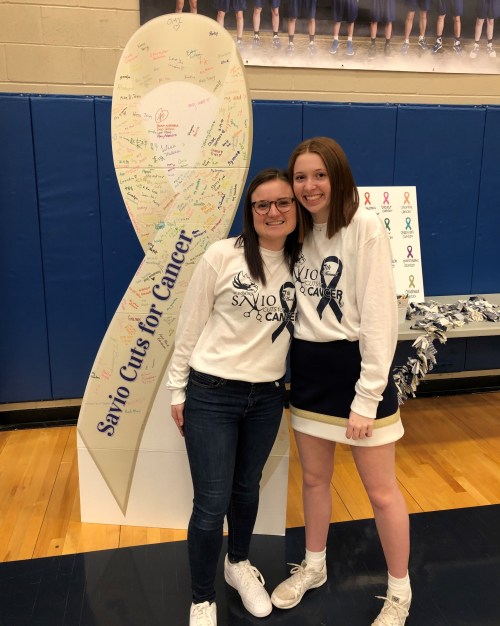
As referenced earlier the younger daughter is on her school’s cheer squad. For the past 7 years that cheer squad has held an annual event called Savio Cuts for Cancer. “Savio” is the short name for St Dominic Savio Catholic High School – a small 400 person school on the north side of Austin. “Cuts” is in reference to students and others in the community donating 8+ inches of hair to an organization that makes wigs for those fighting cancer. And “Cancer”, well sadly I don’t think that needs a description or definition. Tradition is for the juniors on the cheer squad to essentially chair the event – plan the event, find sponsors, arrange for hair stylists to cut hair, promote the event, etc. This year that meant my daughter and one other cheerleader were given the honor of chairing the event. Planning an event takes a ton of time and effort and these two young ladies were definitely up to the challenge. Part of that planning included cheer parents helping set up for the event and being there to guide people to the right places during the event – an event that this year happened to coincide with my birthday.

That is where my third gift surfaced. One does not usually associate work with a being a gift, but when you are supporting a good cause it certainly does. Setting up tables, moving chairs around, hauling boxes from cars, building a balloon arch…all gifts. And then there was the event itself.

  • What a gift to see a charity event coordinated by teenagers go off without a hitch.
  • What a gift to listen to a high school freshman give her personal testimony on her battle with cancer and the importance of her faith and her faith community in her journey over the past year.
  • What a gift to see girl after girl (including my own daughter) give a small part (8+ inches of hair) of themselves to help others.
  • What a gift to see hundreds of kids come down from the gym stands and write down the names of loved ones that have faced cancer.
  • What a gift to see an entire community coming together to stand against a dreaded disease and to remind each other that we are never alone.

c4c


The event was a huge success with close to 150 ponytails collected and over $2,300 raised for St Jude Children’s Hospital. But the numbers pale in comparison to the success of bringing together a community.

My day concluded with dinner and margaritas at an “old Austin” institution – El Patio; opening some physical gifts from the family; and then my traditional yellow cake with chocolate icing. All in all a great day, and a birthday like no other. And yes, I had a good time.

Do I Have a Future as a Futurist?

I’ve been to the year 3000
Not much has changed, but they lived underwater
And your great-great-great-granddaughter
Is doing fine
Doing fine

I took a trip to the year 3000
This song had gone multi-platinum
Everybody bought our seventh album
It had outsold Kelly Clarkson


That’s the chorus from a cover version of “Year 3000“, a song originally performed by British pop punk band Busted in 2002.  The Jonas Brothers released this cover in 2007 with some slightly cleaned up lyrics more fitting their clean-cut boy band image and their pre-teen fan base.  Fun fact, I have seen the Jonas Brothers in concert 4 times (the joys of fatherhood with daughters) but have never seen the pop punk band Busted.

Back in late 2012 I was asked by CenturyLink to contribute an article for an ebook on predictions for business technology in the year 2020. That was not as far out of the year 3000 but with the pace of technology changes, looking 8 years into the future of tech felt like 1,000 years. I have not been able to track down the ebook, but I did blog about my predictions so there is some records of my prognostication.  Now that we have arrived at the year 2020, I thought it would be interesting to take a look and see how my predictions fared over the past 8+ years.

Prediction #1:  My daughter will be close to wrapping up college and entering the professional workforce.

Well my oldest daughter is close to wrapping up college as she is in the middle of her third year at Ole Miss where she is pursuing a degree in Marketing with minors in Accounting and Management Information Systems.  In addition she has her first internship lined up for Summer 2020.  Feel free to direct message me if you need someone with the combo of educational background and skills in mid-2021.

Verdict:  Spot-on.

Prediction #2:  The cube mazes at many offices would go away because people would not need to be plugged into anything to do their work. Note this was the prediction of my then 13 year old daughter.

While there are still plenty of network cables running through office ceilings and walls, the proliferation of enterprise wireless networks has indeed happened.  There are many days when I am either at my official office or at a client site that I never plug into anything.  My device batteries are long lasting, wireless network access is available and through various screen casting technologies I can throw a presentation up on a monitor without the need for cables.  All of this lessened demand on being constantly plugged in has allowed for more open space offices with alternative lounge-like areas where employees can get things done without being tied to a desk or cube.  There are sadly still offices with the dreaded maze of cubes, but for the most part this has little to do with technology constraints.

Verdict:  Not too bad for a 13 year old kid.

Prediction #3:  There will be a continued growth in data still going strong in 2020, which means a continued demand for more and faster storage, faster network speeds, and larger data circuits.

Demand for data storage worldwide has certainly grown over the past 8 years.  Some estimates I have read show the 2012 demand hovering around 2,000 exabytes and the projected demand in 2020 to be over 30,000 exabytes.  That is crazy growth.  This demand for data and the explosion of cloud based solutions has also caused a major shift in the amount of bandwidth needed in the enterprise.  Gone are the days where you could nail up a couple of T1’s as part of an MPLS network for a small satellite office and call it a day.  Now even small offices have demands for connections with much faster speeds and need to implement things like software defined networks.  The corporate data network today looks much different than it did 8 years ago.

Verdict: Spot-on.

Prediction #4: A continued contraction in the size of corporate data centers and the continued expansion of computing capacity being delivered by third-party service providers.

Amazon Web Services, Microsoft Azure Services, Google Cloud Computing Services, and just about any type of application now available on a “as a service” model have seen significant growth over the past 8 years.  While many companies still have data centers (and I am a true believer in hybrid compute) the need for larger data center footprints generally has decreased due to a combination of more compute and storage squeezed into smaller form factors and the above mentioned explosion of “as a service” technology offerings.  The corporate data center is nowhere near extinct, but I think the growth has certainly stopped.

Verdict:  In the ballpark, but not spot-on.

Prediction #5: The install base of desktops and laptops will be reduced substantially by 2020; Tablets and smartphones will be the standard devices in the workplace, and there will be some not yet thought of device form factor emerging as the hot new thing in 2020.

In 2012 the US market share mix between desktops/laptops versus mobile/tablet devices was somewhere in the 80-20 range, with desktops/laptops dominating that overall market.  Fast forward to 2019 and that mix has changed dramatically with desktops/laptops now accounting for around 40% of the market and mobile/tablets in the lead at around 60%.  However, from my perspective this has not been a shift driven by replacement, rather a shift driven by addition.   The mobile/tablet device has not replaced the traditional desktop/laptop.  Most people I see now use a laptop, a mobile device and in many cases also have a tablet. However for most organizations desktops/laptops still dominate the landscape as the go to workhorse device.

And on the device form factor front, I don’t think things have changed that drastically.  Yes laptops have gotten smaller and more powerful and the smart-phones from Apple and Samsung continue to add more whiz-bang features and advanced cameras, but they are for the most part not that different from what was available in 2012.  (Side note:  in my original predictions I said people would still be lining up for the latest iPhone 13, but actually we are only up 11 – but still lining up virtually.)

Some might say the smart speakers introduced during that 8 year span are a new and hot form factor, but again I see those as more additive devices.  Don’t get me wrong, I love being able to turn on lights, control TV remotes, set thermostats, stream my favorite 80s song or have Jimmy Fallon tell me an awesome dad-joke with a shout of my voice.  However, I have yet to really see those smart speakers adopted in the enterprise space.

Verdict:  Swing and a miss.

Prediction #6: For some businesses, the office as we know it today will cease to exist. The office will truly become wherever the employee happens to be, which will surely drive InfoSec professionals crazy.

While there have been ebbs and flows at major companies around embracing the true remote worker, there has no doubt been a continued move towards work happening outside the traditional office locations.  And this trend has certainly driven and will continue to drive InfoSec professionals crazy.  However, I have not seen any seismic shift in businesses doing completely away with the brick-and-mortar (or steel and glass) offices.

Verdict: Not a complete swing and a miss, more like a foul ball.

Overall Conclusion:  So for not having any mystical powers like the legendary Carnac the Magnificent (for those under the age of 50 go Google it), I felt like I did fairly well looking into the unknown of the future. However, I don’t think I ready to rely on my futuristic visions to support the family.  Fortunately, I think the CEO’s in 2020 realize they still need CIOs.


The Shadow Knows

“Who knows what evil lurks in the hearts of men?”

“The Shadow knows!”

These are the opening lines to the popular 1930s radio program “The Shadow.” While the Shadow may have known about the lurking evil, many of today’s CIOs are not so fortunate in knowing where IT lurks across their organizations. That’s right, I am talking about the evil called “Shadow IT.”

For those that do not know what is meant by “Shadow IT”, this is basically when employees within an organization are using systems, applications, software, storage solutions or other technology tools without the knowledge of the organizations designated IT department.

As a former CIO who had open, but properly approved and provisioned, access to the company’s financial transaction data and a background in accounting, I know firsthand that Shadow IT is real. I would regularly query the general ledger and accounts payable transactions looking for expenses or assets that looked to be technology related but were not recorded against the expected GL codes of the IT function. I don’t recall a single time I reviewed such data without coming across some kind of technology spend that was happening outside the corporate IT organization and without my prior awareness.

In addition to those financial transaction reviews, I would also found out about Shadow IT items just by listening and observing. When traveling to different locations around the company, I would make a point to decline to sit in a guest office, instead opting to sit out in an available cubicle or open area work space. This would give me a chance to see and hear how employees worked and in some cases see the use of technology-based tools that I knew were not acquired and provisioned through approved channels.

In all the cases of Shadow IT I came across, I don’t recall any instance where someone was trying to maliciously disregard policies or trying to intentionally put the security of the company (and data) at risk. In general, people were just finding ways to get their job done easier and to better serve their customers; and with the proliferation of applications, systems, storage, and platforms being offered as a service the ability to acquire and consume technology outside the purview of the IT function is becoming easier and easier.

So you may be thinking “what’s the big deal about having Shadow IT?” Two words come to mind: money and risks (specifically data security risks.)

Shadow IT can be expensive for an organization – much more expensive than acquiring the technology through formally established IT procurement processes. This increased expense can be in the form of poorly negotiated pricing, inadequate evaluation of alternative solutions and duplication of technology across the organization. In addition, the cost of Shadow IT solutions are often coded into miscellaneous expense categories or are not scrutinized due to the relatively small amount in the context of the non-IT operating budgets. This can result in unmanaged expenses and at time ongoing expenses for technology solutions that are not even actively used.

Shadow IT can also expose an organization to increased risk related to data security. Typically the core processes and controls an IT function have in place are not applied to solutions acquired and managed outside of the IT function. IT functions usually have established processes and procedures to manage access to technology solutions that ensure that new users are given access only to data that is needed to perform job tasks; that access is removed when employees change roles or depart the organization; and that access to systems is reviewed on a regular basis. Systems and applications managed by IT functions usually also have strict password policies that require complex passwords and require regularly changing of passwords. These strict password controls are often lacking or inadequate in Shadow IT environments. In addition, systems and applications managed by IT functions are typically monitored for patches and updates to address security vulnerabilities. The IT function typically also has processes to receive notices from IT solution providers about security incidents and to respond accordingly. These monitoring and response capabilities are typically lacking for technology solutions procured and managed outside of IT functions.

While I could continue on and on about the security risks introduced or amplified by Shadow IT, I think you get the idea. Shadow IT can also create other risks, such as the administrative access to an application walking out the door with a terminated employee (yes, I lived through that one) or having ownership of a company website domain registered under an employee and not the company and not finding out about until the employee has left the company (again, that happened to me.)

So what’s a CIO to do to try and stop or at least curb the evil known as Shadow IT?

  • It almost goes with saying, but have company policies that require IT solutions be acquired and managed through the appropriate IT function.
  • Create processes that make it easy for other function and their employees to request and consume technology that is managed by the IT function. People are normally like water and will follow the path of least resistance. The easier you make it to use the approved IT services, the less likely it is that someone will look for a different path.
  • Listen to the needs of employees and provide technology that makes it easier and more efficient to perform daily tasks. If you are giving employees the tools they need, the need to go find tools outside of the IT function are diminished.
  • Apply the same listening skills to external customers as well. If the IT function does not provide technology that meets the needs of customers, other functions within the organization that interact more closely with customers will find other avenues to meet the needs.
  • When you find Shadow IT, get the management of the technology in alignment with how other technology is managed. Even if the management tasks are not performed directly to IT staff, make sure it follow establish processes and procedures for the management of technology.
  • Do not be the CI-NO! This doesn’t mean you have to say yes to every request, but the answer shouldn’t always be an outright “No”; sometimes it may be providing an alternative that accomplishes the same goal. Shadow IT is typically a sign that the business, and specifically the IT function, is not providing employees with adequate tools to effectively and efficiently carry out their job functions. If IT is providing the business with the technology needed to be successful, other departments and individual employees will not feel a need to go seek out their own technology solutions.

There were times as a CIO that I got pretty worked up about Shadow IT and would start down the war path to go after those that created it. However, calmer heads almost always prevailed and  I tried my best to use every occurrence of it as a learning experience on where there were gaps in the services being provided to the organization. The learnings would then be used to shape and direct future investments in technology and to improve how IT services were delivered to the organization.  While the impacts of Shadow IT can be evil, the intention of those engaged in Shadow IT are usually good.

“Who knows what evil lurks in the shadows of IT? “ If an organization is lucky, the answer is “The CIO knows!”

Names on the Street

I want to run, I want to hide
I want to tear down the walls that hold me inside
I wanna reach out and touch the flame
Where the streets have no name

I want to feel sunlight on my face
I see that dust cloud disappear without a trace
I wanna take shelter from the poison rain
Where the streets have no name, oh oh

Where the streets have no name
We’re still building then burning down love
Burning down love
And when I go there, I go there with you
It’s all I can do

The city’s a flood
And our love turns to rust
We’re beaten and blown by the wind
Trampled into dust

I’ll show you a place
High on the desert plain
Where the streets have no name, oh oh

I think have a called upon lyrics from U2 a time or two before, and these lyrics from Where The Streets Have No Name from the epic 1987  The Joshua Tree album seem fitting for my latest thoughts.  These thoughts are not literally about being on a street without a name, but certainly about streets where many of us forget there are names.

I recent spent a roughly 24 hour period walking around downtown Austin, TX wearing a yellow t-shirt with the word PILGRIM across the front of it in really large letters.  No I wasn’t part of a Colorado River based re-enactment of the landing at Plymouth Rock – I was volunteering as an adult leader for the St Dominic Savio Catholic High School (www.saviochs.org) junior class street retreat.

The retreat is designed to be a chance to learn through encounters and to briefly be immersed (slightly) in a different experience.  It gives the students (and the adults) an opportunity to learn more about the needs and challenges faced by our brothers and sisters who live on the street. And to see these brothers and sisters in a different light.  The retreat is not a service trip – in fact part of the retreat is to experience being served – something that is uncomfortable for many including me.

The retreat started with 60+ people – all wearing matching PILGRIM shirts – being dropped off near Zilker Park late afternoon and breaking into smaller groups of 6-8 people.  The groups then ate dinner off one of the Mobile Loaves & Fishes (www.mlf.org) trucks – the same truck stocked with the same food items (just extra stocked because they know we will be there) as a normal Wednesday run. The kids lined up with others in our community in need of food and they broke bread and engaged in conversation with those in our homeless community.

It continued with a 5 mile journey through downtown to the University area – but the goal of that journey was not to just reach the destination, the goal was to have the journey – to actually stop and talk to our brothers and sisters that live on the streets, just like you would talk to an old friend you saw walking down the street.  We learned each other’s their names, where we were from, how we ended up in Austin, what we did that day, and in some cases talked about loved ones we have lost.  The night ended with Adoration and a short night’s sleep on the extremely hard gymnasium floor at St Austin’s Catholic School.

Day 2 started with a 4:30 am wake up, and breakfast at one of the downtown soup kitchens (https://www.foundationhomeless.org/programs).  Again not serving but being served breakfast from the same line as 100’s of the homeless and poor of Austin.  Note these are soup kitchens that many of the kids and adults volunteer at on a regular basis – only now they are the ones being served.  After a short daily Mass, it was more encounters on the streets and chances to stop and reflect on and talk about those encounters throughout the morning.

It was inspiring to see these 16 year old kids actually stopping to talk to those that many locals currently vilify due to recent changes to camping/sleeping ordinances that have made the homeless population much more visible around the city.   It was also humbling for me as an adult to have those same encounters with people I myself have ranted about in recent weeks or to be served from a food truck similar to the ones I volunteer on once a month or to walk into a soup kitchen (https://austinbaptistchapel.com/index.html/)  I have volunteered at many times over the past 15 years  – but this time as a person looking for a meal.  Having those conversations and being served instead of serving reminded me that those on the streets or on the verge of being on the streets are no different than me or you – we are all imperfect humans yearning to feel God’s love through one another.

One of the most poignant moments of the retreat for me came as our small group walked past a man – visibly homeless and obviously high – on a sidewalk near one of the downtown churches.  He asked me what was up with the shirts, so I briefly told him what we were doing and we talked for a minute or two.  As we were walking away he shouted –  “I hope you find what you are looking for.” And I turned and shouted back “I hope you do too brother.”

‘The poor have much to teach us – in their difficulties they know the suffering of Christ.  We are called to find Christ in them, to lend our voice to their causes, but also to be their friends, to listen to them, to speak for them and to embrace the mysterious wisdom which God wishes to share with us through them.” – Pope Francis


Leaning into Brotherhood


So just call on me brother, when you need a hand
We all need somebody to lean on
I just might have a problem that you’d understand
We all need somebody to lean on

Those are lyrics from the 1972 smash hit “Lean on Me” by Bill Withers. He also had several another chart topping singles like “Ain’t No Sunshine” in 1971 and “Just the Two of Us” in 1981. I wasn’t a huge Bill Withers fan when those songs were originally released, but as I have aged I have found an appreciation for all of these songs.

I chose this verse of the song lyrics because I am thinking hard about brotherhood right now. I was fortunate to grow up with a pretty good brother, as good as a brother born 7 years before you can be. He taught me a lot of things through the years, some of which I am sure our parents would disapprove of even today. But that is not the brotherhood I am thinking about now. I am thinking about fraternal brotherhood.

In college I never did the Greek Life thing, I started down that path (Delta Upsilon pledge back in 1988) but I decided days before initiation that being Greek in college was not my scene. Fast forward to 2017, and I finally became a full-fledged member of a fraternal organization. No I didn’t go back college for a Ph.D. and join a frat. I joined the Knights of Columbus – the “frat for old Catholic guys.” (Disclaimer – you don’t have to be old to become a Knight, and most of us certainly don’t feel or act old)

Now based on what my college-aged daughter tells me, the KC gatherings are pretty tame compared to the college fraternity parties. Our idea of a good darty (day party for those born before 1995) is sitting around a huge BBQ pit watching 250 pounds of meat slowly smoke to perfection while having a “KC pop or two.” And our house (or hall) is not some large fancy mansion, rather it is the parish hall complete with metal siding. But the brotherhood is real and it is strong. I never imagined being associated with a group of men that care as deeply about each other as the brothers of KC Council 10333. I also never imagined a group of men that sincerely wanted to help their community as much my KC brothers. If a food truck needs to be driven around town to distribute food to the homeless, these guys are on it. If there is a roof leak in the Church during a tropical storm, these guys are showing up with shop vacs in the middle of the night to suck up the water. If there is a need to cook a dinner for a youth group, these guys are on it. If there is a need to drive seniors to doctor appointments, these guys are gassing up the car.   They are truly modern day knights, ready to save the day whenever the call comes.

Over the past 6 weeks of the Lenten season, my fellow Knights and I have been hosting a fish fry each Friday night for the parish and the surrounding community. Imagine 50+ men with varying culinary skills, cooking up meals for approximately 300 people every week. Trust me, it’s an adventure every week, but it always comes together. It is also a pleasure to spend time with a group of men that want to serve God and their community in any way possible – even if that is breading and frying catfish or cooking up 100s of pounds of potatoes. Yes, frying food can be “God’s work.” And let me tell you, the brotherhood bonds grow strong over pots of hot oil.

This brings me back to the song. At our last fish fry, the KCs organized a flash mob of brothers to let our fellow parishioners know that we are all here to be leaned on. Now a few of my fellow brother knights have talented voices, but most of us (me included) have no business even singing in our trucks much less performing in public. But there we were, 50+ brothers standing in front of 300 people belting out Bill Withers’ hit song. (https://youtu.be/OsdVKcAkmoY) I actually think it was a pretty good gift to remind people that you don’t have to face life’s challenges alone. As Bill Withers let everyone know back in 1972:

If there is a load you have to bear
That you can’t carry
I’m right up the road
I’ll share your load
If you just call me


Vivat Jesus

Guess It’s the Egg Bowl for Me Now

Are You Ready?

Hell Yeah! Damn Right!

Hotty Toddy, Gosh Almighty,

Who The Hell Are We? Hey!

Flim Flam, Bim Bam

Ole Miss By Damn!

With a daughter now attending Ole Miss, I will be watching with a little more interest when the Ole Miss Rebels face the Mississippi State Bulldogs in their annual Thanksgiving Egg Bowl football game.  Hearing her talk about that rivalry reminds me of the good ‘ole days when Texas and Texas A&M played each on a regular basis – before the Aggies moved to the supposed greener pastures of the Southeastern Conference.

Last weekend, I attended the Ole Miss – Texas A&M football game in Oxford.  It was cold, wet, windy and the Rebels let the Aggies walk away with a win, but it was still fun to cheer on a team playing the Aggies.  While the Ole Miss fans were far more focused on keeping their fancy tailgate tents from blowing away than caring that the Aggies were in town, hearing that awful Aggie War Hymn fired up in the stadium made the hair on the back of my neck stand-up. It also made me realize how much I miss seeing the Longhorns and Aggies face-off on the gridiron.

Almost six years ago, I wrote about last conference game between the Longhorns and Aggies in a team sport. Since then the head-to-head team competitions between these two schools have been scarce:  5 baseball games (Texas leads 3-2); 1 men’s basketball game won by A&M; 2 women’s basketball games both won by Texas; ; 3 softball games (A&M leads 2-1); and 4 volleyball matches all won by Texas.

Sadly, there have been no football games in those 6 years.  Since then I have been forced to watch the Longhorns try and continue the Thanksgiving weekend tradition against the likes of TCU and Texas Tech.  Yes, they are in-state schools, but it’s not the same as squaring off against the Aggies.  Likewise, Texas A&M has tried to make their annual conference game with LSU into a Thanksgiving rival game, but I am pretty sure that is far from the same as well.  I can only hope some day the two schools can agree to face each other on a yearly basis in all sports – especially football.

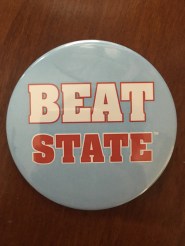
Until then, I will have to get my in-state rivalry fix vicariously through my daughter.  Hotty Toddy and Beat State!

and here’s my walk down memory lane from May 2012…..

Texas Fight, Texas Fight; And it’s goodbye to a&m…….

Good-bye to texas university; So long to the Orange and the White……

If you are from the State of Texas or have even ever been in the state, especially in the Fall, then there’s a pretty good chance you know these words are from the fight songs of the two flagship public universities in Texas. One lays claim to being the first public university in the state and the other claims to be “the university of the first class” in the state.

I am a proud graduate of the “university of the first class,” also known as THE University of Texas and as expected I have many friends that are as well. But I also have many friends (and a few family members) that attended that other university over in College Station. This scenario of “mixed friendships” and “mixed families” has created an intense rivalry both on and off the athletic field.

Believe or not I did not grow up a hardcore Texas Longhorn fan. I was actually more interested in the SMU Mustangs – growing up back in the days of the Pony Express. It was not until I chose to go to UT that my attention really turned to this crazy rivalry. My first in-person exposure to the heated rivalry between Texas and Texas A&M was in the Spring of 1987 during my senior year in high school. By that time I had been accepted to the University of Texas (I chose UT for it’s top ranked Accounting program, not it’s sports teams) and several of my friends had been accepted to Texas A&M. Somehow we convinced our parents to let us take an overnight road trip to College Station to watch a baseball game – without any parents tagging along. It was not just any baseball game; it was a baseball game between the Horns and Aggies.

I don’t recall the score of that game, but the Horns were pretty good that season so I am guessing Texas came out on top. But I do recall the feeling of being out of place in a sea of maroon and white and having a burning desire to talk trash to my Aggie friends when the Horns made a good play. Needless to say, one exposure and I was hooked on the rivalry.

Fast forward 25 years to the Spring 2012, the last year in which the Horns and Aggies will be in the same conference. And for the foreseeable future, the last year the two schools will line up against each other in any sport. I had the pleasure of watching the final baseball game between these two schools this past weekend in Austin with one of my newer Aggie friends – and a former Aggie Yell Leader at that. Texas A&M had already won the series thanks to two solid victories, but bragging rights for that final game were still on the line. As we watched the game we both talked about what a shame it was for such a great rivalry to come to a halt. The trash talk was kept to a minimum, although I did catch my friend mouthing the Aggie version of Texas Fight a time or two. For that most part we were just two guys watching “America’s pastime” – Texas-style.

Lucky for me, the Horns came out on top of the final game with a thrilling come from behind in the 9th inning 2-1 victory. Much like in football, basketball, volleyball, and softball, the Horns baseball team won the final regular season meeting against the Aggies. The Aggies do get to claim wins in soccer, a Big XII title in golf and more than likely conference championships in track, so there is some balance in perpetual bragging rights.

I found it fitting that the last sporting event I watched in person between these two schools was the same as the first sporting event I watched between them. It started with baseball and for now has ended with baseball.

I for one hate to see this rivalry end. Both schools will survive without it, but a little something will be missing. Coca-Cola has Pepsi; McDonalds has Burger King; Superman has Lex Luthor. It’s fun to have a rival.

One can only hope that in time, the two schools will agree to play each other again. Until then we can only hope for some chance meetings in post-season play and hang onto the memories of past contests. And if we are lucky, this is not the death of the rivalry but merely a temporary suspension. But for now, it is (much like the songs say) “goodbye” to the rivalry.

Hook’em!!!

And as painful as it is to type, Gig’em!!!

The Real Friday Night Lights of Texas

Well it’s turn to face the stars and stripes
It’s fighting back them butterflies
It’s call it in the air, alright
Yes sir, we want the ball
And it’s knocking heads and talking trash
It’s slinging mud and dirt and grass
It’s I got your number, I got your back
When your back’s against the wall
You mess with one man, you got us all
The boys of fall

The Boys of Fall by Kenny Chesney is practically a gospel hymn in the football (American football for my international readers) crazed state of Texas.  It’s not often that the Hollywood version of something is a tamed down portrayal, but when it comes to high school football in Texas, the Friday Night Lights movie and television show might not fully capture the insanity that ensues each August in Texas.

Now don’t get me wrong, I love Texas high school football.  I grew up an steady diet of high school football games in East Texas.  I have fond memories as a young kid riding on the cheerleader bus by dad often drove and standing on top of press boxes helping him film games (with a camera with actual film reals) for the dear old Whitehouse Wildcats.  One of the benefits of now having daughters that are cheerleaders, is that I have a perfect excuse for still watching games every Friday night.  However, unlike many in Texas, I am not watching the mega-schools of the state playing.  Instead I am usually watching schools with enrollments of less the 400 students across all  four grades of high school.

As you may recall, my daughters are Catholic school kids.  One recently graduated from St Dominic Savio Catholic High School and the other is a freshman at the same school. Football at private schools is not exactly the same as  at their public school counterparts.  The number of kids playing is much smaller, so small that on many teams there are numerous players that are two-way starters.  It is iron man football.  The coaching arrangements are also very different, with many coaches having other day jobs outside the school. The crowd sizes are also much smaller, usually numbering in the 100s, not the 1000s.  And of course that usually means playing in stadiums that are a far cry from the palaces that seem to constantly  pop-up across the state.

And it is that difference in stadiums that really sticks in my mind as I visit different places on Friday nights.  St Dominic Savio doesn’t even have a home field.  Home games are played on the campus of a nearby public high school, using that school’s practice field that has never been used for an actual varsity football game for that school.  And most of the teams St Dominic Savio plays have “stadiums” that can usually be described as grass fields with a few aluminum bleachers.  There are no video boards, no permanent concession stands (think pop-up tents with folding tables), no hospitality areas (unless you count the lawn chairs in the gravel parking lots) and in most cases no rest rooms that aren’t a good 1/4 mile hike to the nearest building.

These places are a far cry from the $60-70 million high school stadiums that have recently been built in the Dallas and Houston areas of the state.  I think if you added up the cost of all the private school stadiums I have visited over the past 5 years, they would not even come close to the costs of even one of these taxpayer funded monuments to the Texas Football gods.

Fortunately the lack of posh surroundings does not seem to dampen the spirit and determination of these Friday night warriors.  Nor does it seem to hinder the excitement and passion of the fans of those teams.  In fact I think the back-to basics environment enhances the entire Friday Night Lights experience.  I wouldn’t trade all those nights in the cramped, dusty, muddy, buggy football fields for even one night in one of  those gleaming high school football palaces.

Here’s to the Texas private school boys of fall, and their fans – you are the heartbeat of the real Texas Friday Night Lights.

Should I Stay or Should I Go?

Should I stay or should I go now?

If I go there will be trouble

And if I stay it will be double

So ya gotta let me know

Should I stay or should I go?


I am pretty sure The Clash were not singing about career decisions, but the last time I heard this song on The Bat 105 – Austin’s Capital for Classic Hits, it inspired me to ponder a question that almost all people face at some point in their working lifetime.  The question of “should I leave my current job?”

Over my 25 plus years in management roles, I was often asked questions that were in essence “Should I stay or should I go?”  While I never answered the question by belting out lyrics the way Mick Jones did, more times than not I was able to provide some perspective or at least respond back with my own question. In some cases the person asking the question was a direct report or someone from within the same department. In other cases it was a peer in another department or even on rare occasions a person higher up in the organization.  And in yet other cases, the question was posed by a friend that worked for a different company.

In all cases, I am always impressed with the bravery to ask the question and have the discussion. Not everyone is comfortable having a dialogue about potentially changing jobs; so when people engage me on the subject I try and make a true effort to provide valuable insight.  I usually start by asking “why are you considering making a change?”  The answers vary from a desire for more compensation, to lack of career advancement, to too much travel, to boredom, to dislike of co-workers or company, to wanting to make a radical career change, and to long work days or stress eating away at family time.  Depending on the answer to the first question, I might follow up with something like “are you happy doing what you are doing?” or “does your current job make you feel fulfilled?”  or the ever popular “so what do you want to do when you grow up?” These will usually spur more conversation and in most cases that will lead to additional reasons for wanting to make a change or not make a change.

Depending on where the conversation goes, I might even use my own journey from which to pull examples of times I either made the decision to make a change or stay put.  Granted most of my job changes might seem radical to some, but there was usually some point in one of them that could fit the situation.  My first big change from government accountant to Big 4 consultant was driven by a desire to not do accounting, and to lesser extents much better compensation and making good on a “threat” I made to leave the agency I was working in if they moved me on to a team working on what I considered an already doomed project.  My next change to leave the interesting world of Big 4 consulting and land in corporate-America was driven by a strong desire to spend more time with my young family.  The grind of traveling 5 or 6 days every week was too much.  And my latest change from corporate CIO to independent management consultant was driven by the realization the corporate officer role I had chased for many years did not bring the expected feeling of joy.  In short, I was not happy and went back to the role, management consultant, that brought me the most happiness – this time without the extensive travel.

Not once did I look back and question my decision to make a change, but trust me, each decision was not made lightly.  Any time that “stay or go” question creeped in my mind, I stopped and assessed the situation.

What is making me ask the question?

Is my current role fulfilling?

Am I growing professionally?

Is my current job pulling me away from other more important things in my life?

Am I happy?

In most cases I tried to seek out the advice of others.  I also tried to balance that input from others with what my mind and my heart were telling me.  In the end, I always went with my heart because I knew that would lead me to make the right decision.  There were times the heart said “stay” and others when it said “go”; looking back the choice was always spot on.

Ultimately the decision to make a change is yours to make.  Getting advice from others can help bring it all into focus, but in the end you have to make the choice.  You can beg and plead for someone else to let you know, but only you can answer the question “should I stay or should I go?”