Archive for the 'Leadership' Category

Should I Stay or Should I Go?

Should I stay or should I go now?

If I go there will be trouble

And if I stay it will be double

So ya gotta let me know

Should I stay or should I go?


I am pretty sure The Clash were not singing about career decisions, but the last time I heard this song on The Bat 105 – Austin’s Capital for Classic Hits, it inspired me to ponder a question that almost all people face at some point in their working lifetime.  The question of “should I leave my current job?”

Over my 25 plus years in management roles, I was often asked questions that were in essence “Should I stay or should I go?”  While I never answered the question by belting out lyrics the way Mick Jones did, more times than not I was able to provide some perspective or at least respond back with my own question. In some cases the person asking the question was a direct report or someone from within the same department. In other cases it was a peer in another department or even on rare occasions a person higher up in the organization.  And in yet other cases, the question was posed by a friend that worked for a different company.

In all cases, I am always impressed with the bravery to ask the question and have the discussion. Not everyone is comfortable having a dialogue about potentially changing jobs; so when people engage me on the subject I try and make a true effort to provide valuable insight.  I usually start by asking “why are you considering making a change?”  The answers vary from a desire for more compensation, to lack of career advancement, to too much travel, to boredom, to dislike of co-workers or company, to wanting to make a radical career change, and to long work days or stress eating away at family time.  Depending on the answer to the first question, I might follow up with something like “are you happy doing what you are doing?” or “does your current job make you feel fulfilled?”  or the ever popular “so what do you want to do when you grow up?” These will usually spur more conversation and in most cases that will lead to additional reasons for wanting to make a change or not make a change.

Depending on where the conversation goes, I might even use my own journey from which to pull examples of times I either made the decision to make a change or stay put.  Granted most of my job changes might seem radical to some, but there was usually some point in one of them that could fit the situation.  My first big change from government accountant to Big 4 consultant was driven by a desire to not do accounting, and to lesser extents much better compensation and making good on a “threat” I made to leave the agency I was working in if they moved me on to a team working on what I considered an already doomed project.  My next change to leave the interesting world of Big 4 consulting and land in corporate-America was driven by a strong desire to spend more time with my young family.  The grind of traveling 5 or 6 days every week was too much.  And my latest change from corporate CIO to independent management consultant was driven by the realization the corporate officer role I had chased for many years did not bring the expected feeling of joy.  In short, I was not happy and went back to the role, management consultant, that brought me the most happiness – this time without the extensive travel.

Not once did I look back and question my decision to make a change, but trust me, each decision was not made lightly.  Any time that “stay or go” question creeped in my mind, I stopped and assessed the situation.

What is making me ask the question?

Is my current role fulfilling?

Am I growing professionally?

Is my current job pulling me away from other more important things in my life?

Am I happy?

In most cases I tried to seek out the advice of others.  I also tried to balance that input from others with what my mind and my heart were telling me.  In the end, I always went with my heart because I knew that would lead me to make the right decision.  There were times the heart said “stay” and others when it said “go”; looking back the choice was always spot on.

Ultimately the decision to make a change is yours to make.  Getting advice from others can help bring it all into focus, but in the end you have to make the choice.  You can beg and plead for someone else to let you know, but only you can answer the question “should I stay or should I go?”
The Bloody Project – Another Lesson From the Course

I’m alright and nobody worry ’bout me

Why you got to gimme a fight, can’t you just let me be?

These are the unmistakable opening lines of the theme song to Caddyshack.  As a fan of slapstick comedy and of the game of golf, I have to rate it as one of the classic movies from the 80’s.

One of the  benefits of my recent career changes was to have a little more flexibility in my schedule; a flexibility that would allow me to spend more time with my family.  Last week, I had the chance to exercise that flexibility and booked a round of golf with my oldest daughter and one of her friends.  With my less than spectacular golf skills, I highly suspected there could be a slapstick moment on the course.

It was a typical winter day in Central Texas – sunny, not hot but not cold, not windy – a day my friends in northern climates couldn’t even imagine exists in late January.  After working from the world headquarters of Nice Socks Consulting for the morning, I headed to our home course at Avery Ranch Golf to meet them when they got out of school that afternoon.  I was excited to spend some quality time with her before she heads off to a college yet to be determined later this year.

The course was not busy so we were excited about enjoying a casual round without anyone pressing on us.  As we teed up on the first hole, little did I know that our round would be far from casual.  My daughter’s drive pushed a little right of the fairway, ending up on a slight slope near a small outcropping of limestone just to the front and right of where her ball landed. She was about 120 yards from the green and confident she could be on the green in regulation. Unfortunately, the 2nd shot did not go as planned.  Her ball hit the rock outcropping (yes, she let the club face open up) and bounced directly back, striking her in the head.

At first I was not sure what had just happened.  I was watching for the flight of the ball and when I did not see the ball in the air, turned around to see her kneeling on the ground.  She had her hand on her forehead and when she moved her hand, I saw the blood.  Lots of blood.  I ran to my cart and grabbed a golf towel to apply pressure and slow down the bleeding. I won’t go into the gory details of the next few hours.  However, I will let you know that after 7 stitches expertly applied by a plastic surgeon, she was all good.  No concussion. No life altering injury.  Just a nasty wound that will heal and hopefully leave nothing but a faint scar.

As I am apt to do, once I knew for certain that this incident was not going to result in long-lasting impact on my daughter’s health and well-being, I started to think about what I could learn from this life event.  At first my mind went to thinking about being prepared for the unexpected. However, the more I thought about it, the more I began to see that the potential for a project management lesson to come out of this unfortunate event.  This angle is probably due to the fact that my first consulting engagement since going out on my own is focused on driving a significant solution platform rationalization project.

Most projects start off with a well thought out plan with well-defined milestones and details on the steps required to meet those milestones.  The approach to a round of golf is similar.  You know the par on each hole and know in general where you need each shot to go in order to meet or beat par.  But we all know that not everything goes according to plan on the course nor in the office.  Therefore, you have to be able to adjust as the round unfolds; you have to manage the round, just like you have to manage a project.

In the case of my daughter, she had planned for her tee shot to go up the right side of the fairway and land 100-110 yards from the middle of the green. She then planned to hit a nice easy approach shot into the green where she would do no worse than two putt and make par or better.  Instead her tee shot went a little further right than expected and landed in the rough, on uneven ground, near an outcropping of rock, about 10 yards shorter than expected.  Her second shot then proceeded to hit the rock outcropping and end her round prematurely after two strokes.

When assessing what to do after that first shot, she had five options. One option was to play the ball as is and go for the green to get back on plan. The second option was to chip out onto the fairway giving up distance to have a much better position for her next shot.  The other options (per rule 28 of the Rules of Golf) involved declaring the ball unplayable and 1) going back to point of her first shot and hit again under penalty of stroke and distance per rule 27-1; 2) taking a one stroke penalty and dropping a ball behind the point where the ball lay; or 3) taking a one stroke penalty and dropping a ball within two club-lengths of where the ball lay, but not nearer the hole.

The execution against her project plan for Hole #1 was off-track after her drive.  In this case, she decided to take an action to get back on plan with one swift action versus incurring an additional stroke.  I had seen her make similar shots  from similar positions on that very hole before, so in the moment I did not suggest she do otherwise. Sadly, that swift action ended the round and resulted in a trip to the ER.

In hindsight, the safer more practical play would have been to give up distance and punch it into the fairway to set-up her 3rd shot or perhaps declaring the ball unplayable and taking a drop with a penalty stroke.  In either scenario, she would have likely had a ball on the green sitting 3 with a chance to sink a putt for par or at worse bogey.

She made a decision to go for the green rather than take the less risky option of taking an extra stroke on the hole. While the reward for going for the green was large, so was the risks. They say hindsight is 20/20, and in this case I can’t help but second guess not suggesting she choose another option.

Those same decision points haunt project managers.  No matter how well-managed, there are usually issues arise that could potential get a project “off plan.”  Many of those issues are minor and can easily, without introducing more risks into the project, be identified and addressed quickly.  But at times the issues appear abruptly and are significant and can only be solved by either taking a risky bold action that could get your project back on plan in one swift action but also introduce risks of incurring further negative impact to the project (i.e. your project ends up in the ER); or taking a less risky action that has some short-term negative impact (i.e. you take another stroke on the hole) but sets your project up for long-term success.

In the early days of my career I was usually inclined to “go for the green” when faced with one of those decisions as a manager.  But as I gained experienced, I learned that sometimes taking the penalty stroke or just punching out to the fairway is the better course of action.  As a project manager (or any kind of manager for that matter) you have to assess the risks presented you and make a decision that gives you the best chance of achieving the ultimate objective of the project.  Sometimes that means going for the green and other times it means taking a penalty stroke.  The main thing is to keep yourself and your project out of the ER.

Fore!


Beware of the Lime Juice Ship

If you want to join a merchant ship and sail the sea at large
You’ll not have any trouble if you have a good discharge
Signed by the Board of Trade with everything exact
And then you’ll get your months advance according to the Act.

So haul boys your weather mainbrace and ease away your lee
Hoist jib and topsails lads and let the ship go free
Shout boys shout I tell you it’s a fact
There’s nothing done in Lime Juice ship contrary to the Act
Now when you join the ship me boys you’ll hear your articles read
They’ll tell you of your pork and beef your butter and your bread
Your coffee, tea and sugar boys your peas and beans exact
Your lime juice and your vinegar according to the Act

These are lyrics from an old sailor song called the Lime Juice Ship. I know this is a departure from my typical use of modern music, but bear with me. As usual there is a method to my madness.
For Father’s Day my children gave me a book of “useless facts.” I assume because they know how much I love boring them with stories about supposed randomness. I took the book on a recent vacation flight, and quickly read it from cover to cover. While it was a purely pleasure trip, my mind couldn’t help but think about the world of business while I amused myself reading utterly random factoids.

One of the stories in this book of useless facts was answering the question: “Why are the British referred to as limeys?” According to this book (and I have not done any independent research on this to confirm), it all has to do with scurvy and the British Navy. Apparently in the 17th to 18th centuries the greatest killer at sea was scurvy which is caused by the lack of ascorbic acid in the diet of a sailor. In 1753, a Scottish naval doctor, James Lind, recommend adding lemon juice, which contains ascorbic acid, to the sailors diet to prevent scurvy. Initially the British navy ignored the recommendation due to cost concerns, but by the late 1700s lemon juice was compulsory aboard British navy ships and scurvy ceased to be an issue. However, at some point in the 1800s the British navy switched to lower cost lime juice, only to see outbreaks of scurvy return to their ships. Turns out that limes have a lower content of ascorbic acid than lemons and thus were not as effective at fending off scurvy. Other countries stuck with higher cost lemons or even oranges and did not see the return of scurvy. Sailors from other countries, particularly the Americans and the Australians, poked fun at the British sailors by calling them “limeys.”
Like most people who have held a position within companies for more years than you care to admit, I have seen my share of business downturns – either firsthand, through experiences with business partners, anecdotally through IT peers and acquaintances, or reading business-related articles. These downturns may be result of worldwide, national or local economic problems; product relevance or reliability; price pressures; the poor execution of business plans; or a host of other reasons. Regardless of the driver, one of the most common reactions taken by the management team of the business is to cut costs.


Now don’t get me wrong, I love an ongoing strong dose of expense management. Building in a recurring examination of your business’s cost basis is a good thing. Businesses are dynamic; and employees at all levels of an organization should be evaluating and challenging business processes and costs associated with the business all the time. This leads to a business where the right people are doing the right things, following the right processes at the right times. This results in an efficient business operation, something that is key attribute of high performing companies. I like to think of this as “natural” expense management that happens as part of following strong fundamental business practices.
However, during business downturns, what I have seen and heard from others so many times is what I call “unnatural acts” of cost cutting. Much like some Royal Navy admiral requiring the use of limes instead of lemons to save a few British Pounds, CEOs and CFOs go to department heads requiring an arbitrary and immediate cost basis sacrifice – especially from departments that are seen as support functions or ones oddly enough that are focused on driving sales. While these actions can prop up financial performance in the short-term, they can also cause longer-term harm (perhaps not death like the actions of the British navy) to the business.
Ring, ring….”Hey VP of HR, this is your CFO calling on a Monday morning. Look I know our overall employee count is forecasted to remain flat for the coming 12 months, but I need you to scale back your HR department cost basis by 10% to help make up for the recent 5% price decrease we did on our flagship product. No rush, just let me know Wednesday what steps you are going to execute on Friday to achieve the target.”
Knock, knock….”Hey CMO, this is your CEO stopping by to talk about a problem. As you know, our sales numbers are trending down and the full year forecast is bleak. We just can’t seem to get sustained traction with our new product line. Our customers just don’t seem to be aware of all the great features we introduced with it. Let me know by the end of the week how we take $2 million out of product marketing for the remainder of the year.”
These are completely made up interactions to make a point about the short-term decisions that occur all too often in businesses today. The focus on beating financial performance over an arbitrary 90 day reporting period compared to a year ago seems to be the norm in many companies today, especially those that are publicly traded. This can result in executing actions that are not in the best long-term interest of any business stakeholders. It seems the notion of focusing on long-term sustainability of a business that benefits all the stakeholders in a business – investors, employees, customers, suppliers, communities and beyond – is a forgotten idea.

Call me crazy, but I for one think we need to resurface that idea.

I Found Help (and Hope) in Orlando: And I Wasn’t Even Looking For It

Help, I need somebody

Help, not just anybody

Help, you know I need someone

Help

“Help” is one of my favorite songs from that lovable British boy band, The Beatles.  As you start reading this you will more than likely be thinking  “what do these lyrics have to do with these ramblings?”, but stick with me.

I had to attend a company conference this week in Orlando, Florida.  And quite frankly in the days leading up to the conference, I was less than 100% enthused to be attending.  I was going to miss several of my kid’s activities during the week; my wife was going to have to play single parent for most of the week; I was on the agenda to present; and overall I thought “been there, done that.  I’ve seen this show before.”

There is still one day left in the conference, but my attitude has changed.  The feel of the conference; the content of the conference; and what I am getting out of it is much more than I ever imagined.  But that doesn’t make a great story, nor is it what spurred me to write about it.

As part of the conference agenda, we had a social responsibility event.  But unlike some other charitable exercises at these types of events, this was not just going out and picking up trash, or working on a house, or beautifying a park.  Now don’t get me wrong, these are all fine things to do.  However, the event at this conference was geared around leveraging the collective marketing expertise that the employees of our company possess.  The event was to create marketing plans for 8 Orlando-area charities, and to then compete in a marketing strategy throw-down in an effort to win $10,000 in marketing services for one of the organizations.

I had the good fortune to be on a team working with Shepherds Hope, a faith-based organization running 5 medical clinics providing free medical services to the uninsured  – and yes despite ObamaCare and all it’s promises there is still and will continue to be a large population of people without medical insurance – in the Orlando area.  The story of the inspirational start of Shepherds Hope, the heart-wrenching stories of patients saved by the services provided, and the thousands of hours of service donated by area medical professionals were awe inspiring.  I think each of my colleagues on the team were brought to tears as we learned about what this organization does in the community.

What changed my attitude was the passion that was exhibited by my fellow co-workers as we in 2 short hours put together a marketing plan for this great organization.  Most of us on the team were not from Orlando, and several were not even from the United States, yet we all felt an immediate connection to this organization.  I was inspired by the collective talent of the group; each of bringing unique skills to the table in an effort to make a difference in the lives of people we will never even know.  To the last person on the team, we all wanted to help Shepherds Hope by providing them the seeds for a marketing plan to attract more medical professionals, attract more and larger monetary donations, and in the end to help them improve the lives of so many people.  This wasn’t about closing a sale for our company, or hitting some financial performance target; it was about using our special talents to help others.

Well it turns out that our team did not win the marketing pitch show-down, but our company graciously donated $7,000 in services to each of the 7 “losing” organizations and the members of my team (without provocation or threat from anyone) all committed to donate personal hours to supplement the $7,000 so that we can help make Shepherds Hope’s dreams for more medical professionals and more donors a reality.

What I thought was going to be just another charitable event where I and others without much effort, thought or connection to help a community, turned out to be so much more.  It turns out, I was the one helped.  I was helped by the dedicated staff of Shepherds Hope and the other charities that reminded me that there are measures of operational success much more important than revenue and OI.  I was helped by my fellow co-workers that reminded me of the passion that we all have within us and the immense amount of marketing talent we possess within our company.  This helped me realize, that while things may not be perfect in our company, we have the passion and the expertise to make it so much better.  I didn’t fly to Orlando thinking I needed help, but I did, and fortunately I found it.

If you would like additional information on Shepherds Hope, you can visit their website (hopefully soon it will be a better site) at www.shepherdshope.org and you can follow them on Twitter @shepherdshope

Weird Science: Your Business Might Just Need Some

From my heart and from my hand and
Why don’t people understand my intentions?

Weird science
Magic and technology
Voodoo dolls and chants
Weird science

It’s been several months since my last post, and I come back with some random lyrics from 80’s New Wave band Oingo Boingo.  In case you don’t recognize the song, it is Weird Science, a song that supposedly the members of the band did not care much for and rarely performed live.  The song was also the title song for the soundtrack of a John Hughes movie with the same name – and yes I had a celebrity crush on Kelly LeBrock back in the day.

Today the lyrics serve as an “answer” to something that has perplexed many a person over the years:  what makes a team (or organization) perform at a high level?

I know there have been many books, columns, and Phd. Dissertations written on the subject.  There are all sorts of ideas on how to formulate a high performance team that gives you synergy, i.e. the interaction of elements that when combined produce a total effect that is greater than the sum of the individual elements or contributions. I don’t think anyone is 100% sure how to achieve synergy in organizations, so I am just to chalk it up to a little bit of “weird science.”

I started thinking about this about 3 months ago when my daughter tried out for the junior high volleyball team.  She ended up on the mid-level squad with other girls that were deemed to be average players, but not one of the best 10 that made the top squad.  During early season practices the top-level and mid-level teams scrimmaged, and the mid-level team typically won set after set against the team with the more skilled players. My daughter’s team then went out and won the first game of the season, and then won the next one, and the next one, until we looked up and that group of average players had done something that no volleyball at that school had ever done – they had a perfect season.  11 matches, 11 victories.  Not bad for a group of girls that individually were not assessed as being the best players.  I guess you could called it an example of synergy, but I just called it fun.

Throughout the volleyball season, I kept thinking about what made that team successful.  Perhaps it was that during tryouts the coaches evaluating the players were wrong on all 10 players.  Or maybe it was the sheer coaching talent of volunteer parent coaches of the mid-level team. Or maybe it was just some “weird science” that somehow took a group of average players and turned them into a great team.    I did make some observations during the season that just might be factors in the team’s success:

1)    They did not get overly stressed about the games.  During pre-game warm-ups or time-outs you would see them dancing around sometimes even when no music was playing.  They looked like they actually enjoyed being together on the court.

2)    They did not get mad or angry when a teammate had a poor serve, shanked a return or watched a ball drop in front of them.  They simply chanted “shake it, shake it off” and went on to the next point.

3)    In matches where the team dropped a set, the team always came back the next set with a higher level of energy.  They did not let losing the first set, make them lose the next one.

4)    And before, during, and after each match; they prayed.

I am sure there were many other factors that went into this group having a great season.  Whatever all those things were, they had to come together in just the right levels to achieve the desired end result.  The interesting thing is that there was not a recipe that listed the exact amount of each thing and the order in which to add them and mix them together.  While there was some deliberate things done in order to position that team to excel, there was also a little bit of magic involved in having a perfect season.

Many years ago in the business school, I remember taking Marketing 101 where they taught the 4 P’s:  Product, Price, Place and Promotion.  The professors made it sound so simple:  all you needed was the right mix of those four things and you could have a highly successful business.  20 plus years later and I can tell you that it is not that simple.  Through the years, I have figured out that there may be just a few more factors involved in a successful business and that knowing exactly how to blend all those ingredients is far from easy.  I have also learned that while many people have written business cookbooks, there is no magic recipe that you can just follow and find success.   Yes there are some tried of true things you can do to position a business to succeed, but just like in volleyball, you gotta have a little “weird science” to bring it all together – but maybe without the voodoo dolls and chants.

Great American Hero: A Story of Courage and Heroism in Small Town Texas

Believe it or not,

I’m walking on air.

I never thought I could feel so free-.

Flying away on a wing and a prayer.

Who could it be?

Believe it or not it’s just me

These are lyrics from the chorus of the theme song from the Greatest American Hero, an early 1980’s television show about a high school teacher who receives a special red suit from space aliens that when worn gives him superhero powers.  He then teams up with a FBI agent to save the world time and time again.  A story about the average man turned superhero.  It’s not quite Batman or Superman but good enough to last 3 seasons on network television.

There are many types of people we hold up as heroes.  There are legendary historical figure; for some there are political heroes, and for others sports heroes. While you could make the case that some of these are not worthy of hero status, they have that status nonetheless.   We look up to them; we make movies about them; we idolize them and we place them on pedestals as these great humans that are somehow superior to the average person.

A little over 90 days ago, an explosion happened at a fertilizer facility in the small Texas town of West.  The night of the explosion and the subsequent days and weeks exposed us to a different kind of hero – the average everyday person that found themselves faced with unimaginable challenges.  The world heard about some of these heroes, mainly the first responders that lost their lives responding to the explosion, as there was extensive media coverage of the event.

We heard about the brave volunteer firefighters that perished at the scene.  Each one not hesitating to rush into danger – not because it was their job, but because they were protecting their community, their friends and their neighbors.  The nation and the world mourned the death of these first responders.  Arenas filled with people from all over to memorialize these brave men.  Reporters scurried about town to get the inside story.  The names of these fallen heroes will certainly not be forgotten for years to come.

But the story of heroes in West goes much deeper.  There were hundreds of people that carried out heroic actions that night and the subsequent days.  There were staff members of a local nursing home that ushered elderly residents to a safer part of the building in the minutes prior to the explosion. There were teenagers that wheeled and carried injured victims to a nearby makeshift triage center.  There were brothers, sisters, aunts, uncles, and parents that rushed to houses to pull out trapped family members in the darkness and chaos of the night.  There were firefighters, medics and police officers for miles around that responded to the aftermath of the explosion.  There were untold volunteers that flooded into town that night and the days following to offer aid and comfort to all those that were impacted by the explosion.  We will never hear or see the names of most of these people, but it will not change the fact that they are indeed heroes.

One of those unknown heroes has a special place in my heart.  She is my sister-in-law, Judy Knapek.  Judy is a member of the West Volunteer Fire Department – one of the few females that have ever been a member.  She was one of the numerous firefighters that responded to the emergency call about a fire at the fertilizer facility.  She was there at the facility when the fire triggered the deadly explosion.  By the Grace of God she was not physically injured by the explosion.  But she saw fellow injured firefighters stagger towards her and carried several out of harms way and got them to paramedics.  She spent endless days and nights at the fire station in the days and weeks after the explosion filling out the tons of paperwork that goes along with a disaster like this one, accepting donations from all over the world, and providing information to concerned citizens.  She did all this while knowing that many of her firefighting brothers, including two of her cousins, did not get to walk away from that deadly explosion.

The things these everyday people did are amazing to me.  But if you were to ask Judy or pretty much anyone else in West that responded in some way to the explosion, they would tell you that they were not heroes.  She and others would just say that they did what anyone would do in that situation, but I disagree.  I think Judy and many others in West fit the true definition of “Great American Hero.”

Buckle Up, Buttercup!

Ch-ch-ch-ch-Changes
(Turn and face the strain)
Ch-ch-Changes

You should know by now that I like music, and this time I have turned to David Bowie to lead us in to this installment. I actually used this same lead in back in March 2012 when I penned Business Lesson from a Nurseryman: Change Can Come Up Roses. Back in March 2012, I was talking about changes in a “family” business. Today, the scope of discussion tackles a much larger business.

For the fourth time since I started at Harte-Hanks in 2001, a new CEO has been announced. That means I am faced with working under my fifth CEO in 12 years; so change in leadership is nothing new for me and nothing new for millions of other people working in companies, large and small, across the world. What is different for me is that this CEO, unlike the other ones in the past decade, is a complete outsider.

The day of the announcement I had several people come into my office and ask me if I knew anything about this new guy. While I had not met him nor spoken to him, I had done a quick Google search on him that scored a few interview clips. While I did not know much about him, I shared what little I did know while trying to not throw in any conjecture. I made sure to tell them that I liked his Irish accent, especially since I claim to be (if you trace back enough generations) part Irish and that I was hoping we might see St Patrick’s Day become a company holiday. Sadly our VP of People has since told me that offices will NOT be closing on March 17 each year.

It was the second question I was asked by those people that I knew probably a large majority of other people in the company wanted to also ask:

“Do you think things will change with the new CEO?”

Each time this question was asked of me, I provided the same initial answer:

“I certainly hope so, otherwise why would we make a CEO change.”

I am not sure that was the answer people wanted to hear, but it felt like the right answer to me. Yes, I expect there to be changes. I expect some of the changes will be ones I like, while others may not be to my liking. But driving change is part of what makes a successful leader, so I fully expect a new CEO to make changes. Organizations must change in order to stay competitive and succeed, and leaders, at all levels, must be the champions of change.

I am not sure what the coming months will bring as our new CEO takes the reigns, but I do know it will be different from what it is today. I also know, I will do my part to champion those changes because that is what leaders do.

I hope my fellow co-workers are ready to say “game on” and embrace the coming changes as well. Of course the transition will have its bumps but hopefully we can anticipate and brace for those challenges. In the words an old high school basketball teammate liked to say before the big games against our toughest competition: “Buckle Up, Buttercup!”

It’s 2013: Be Joyful

Joy to the world
All the boys and girls, now
Joy to the fishes in the deep blue sea
Joy to you and me

I might be a little young for early 70s rock, but I do love me some Three Dog Night.

New Year’s Eve is a special day in the Neill house. In addition to the obvious, it is also the day we celebrate the Lovely Mrs. Neill saying “I Do” to spending a lifetime with a slightly dorky accountant back in the mid-90s. Due to this, my oldest daughter has insisted from a young age that NYE is a family occasion – not one to be celebrated without her and her sister’s presence. NYE 2012 was no exception.

Now how we celebrate each varies and in some years plans don’t gel until the day before or day of NYE. 2012 was one of those years. We had some friends over on the 30th for dinner and they mentioned they were having a little get-together the next night at their house. So the next morning, we pulled together our celebration: NYE Vigil Mass, a nice diner out, and a swing by our friend’s gathering. Well when you wait until the morning of NYE to make dinner reservations, you don’t always get the exact times you want. We ended up with a dinner reservation time that made it impossible to make it to our local parish’s Mass, but we found a time that would work at a neighboring parish.

While selecting a Mass time based on dinner reservations is probably not ideal, sometimes things just work out for the better. The priest at the parish we ended up at was the priest that had guided me through the conversion to Catholicism a decade ago. He always had a way of delivering a message in his homily that resonated with me and his NYE homily was no exception. I am not going to go into the biblical / theological aspect of his homily but his message was one that should hit close to home for most of us.

In two words the message was “Be Joyful.”

We spend too much time in our daily lives focused on the negative and worrying about the bad things going on. We are bombarded with “the negative” from all sides. Our news outlets are constantly hitting us with bad news about death and destruction. Our work days are filled with pressures to perform better on an individual and collective basis. Business leaders are faced with the demands to continually grow revenue and income less face the consequences of falling stock prices. Kids in school are faced with the daily pressures to exceed expectations in the classroom, the playing field, and in the hallway. With all these pressures and negative news, many of us find ourselves not enjoying life. We are constantly worrying about the potential negative things. We are alive, but we are not living.

The message on NYE was simply to enjoy life. Celebrate living each day. Use the talents you have been given to make the world a brighter place. Now that is certainly easier said than done, but I made a commitment right then and there to make it a priority to be thankful each day for having the opportunity to be alive. While I have no doubt that “bad” things will happen in our world and some of those things will hit close to me, my goal is to find joy in each day.

Think what our world would be like if we could all do that every day.

The Love Train

When love comes to town,
I’m gonna jump that train
When love comes to town,
I’m gonna catch that flame
Maybe I was wrong to ever let you down,
But I did what I did before love came to town

Nothing like a little BB King and U2 to start things off.

I have written a little on this idea of love in business in the past. You may recall a blog centered on Kip Tindell from Container Store and a keynote speach I heard from Chris Lowney reflecting on the Jesuit philosophy on leadership. Since then I have not been able to shake this idea of business love.

I will be the first to admit that I have never been the poster child for touchy feely leadership. For the most part the places I have worked over the past 20 years had management teams that were cut from the same cloth – the cloth of management with a good dose of fear perhaps sprinkled in with a jagged version of tough love. Now don’t get me wrong, I have worked under some highly intelligent, highy motivated, and sucessful leadership teams. But I doubt many would use the word “love” to describe those leaders.

Those radical Jesuits had a different idea about this leadership thing. Their version of leadership was to see the potential in each employee, to make a commitment to unleash that potential and to cultivate the resulting loyalty and support to unite and drive a team to success. That is their idea of love-based leadership. To see the potential in a person and to help that person reach that potential. It is a concept that is based on the thought that all employees are self-motivated to achieve success and that the leader’s role is to help by putting each person in situations to succeed and to give them the tools they need to succeed.

For me, I doubt the majority of the management teams I have worked under in my career would ever be considered as the face of “love-based” management. There may have been moments of love and compassion but for the most part the management styles have been motivation by fear and tension. That said, those teams and the resulting business results were generally succesful, but it makes you wonder if the results could have been even greater with a more loved based leadership approach. There is no way to go back and replay the past, so all we can do is ponder that thought and perhaps learn from it.

It is said that your style of management is shaped by those who have managed you, and I think that is true to an extent. While I don’t think I am as hard core as some of my former bosses, I do think my style has been influenced by them. Fortunately, I also think that you are influenced by others around you and what you read and hear. I am grateful to have been able to watch strong leaders succeed using techniques more in line with the Jesuit style of leaderhship and to be exposed to books, articles and speakers that get there is more than one way to lead. Whether it is listening to the likes of Kip Tindell, watching how my own father lead a school district or reading books on the subject; I have come to realize that one can lead and manage without using fear as the main motivator.

I am not fully on the “love train” just yet, but I have jumped into the boxcar and am slowly pulling my body all the way in. Hopefully some day I will make my way to the engine and drive that train.

So once again, here’s to love in business and hoping it comes to a company near your soon.

Disney World Made Me Think About Business

It’s a world of laughter
A world of tears
It’s a world of hopes
And a world of fears
There’s so much that we share
That it’s time we’re aware
It’s a small world after all

Once that song is stuck in your head, it’s hard to get it out. At the start of June, we headed off on a family trip to Disney World. Unlike all our past trips which involved flying, we decided to make this one a good old fashion road trip. So we loaded up the family truckster and headed east. While I am not to a point of saying that every trip should be a road trip, it was a nice change of pace to see parts of the country from 2 feet of the ground instead of 30,000 feet.

Disney World was great – even if the weather was not. We road many a ride, spent some time getting to know some of our newer friends and most importantly got to watch our daughters’ dance teams perform on stage at Disney World. Great memories were made that we will all have for a lifetime.

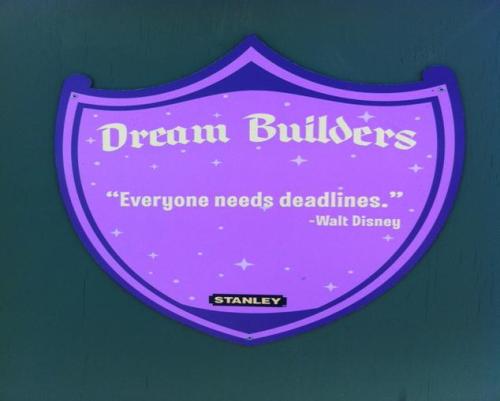
But since this is not a travel blog, I am going to change gears a little. As we were walking through Fantasyland on our first day at the park headed to the It’s a Small World ride, we passed by a new area of the park that is under construction. The site was surrounded by tall walls and posted on the walls were insightful quotes from Walt Disney. There had to be 40-50 quotes in total and as much as I wanted to read each and every one of them, I did not. I doubt the rest of the family would have thought that was a good use of our time – especially when you consider the cost of tickets to get into the park. But I was able to read a few of them and there were two that really hit home – so much that I quickly snapped pictures of the signs.

The first sign that caught my eye was this one.

It’s a short quote of just three words, but how profound those three words are in the world of business. Once I read that sign, I immediately started thinking about all the projects that I had going on back at work. I know that is a pretty sad thing to think about while on vacation, but when something hits you, you go with it. While I don’t have any projects as big as building an entirely new Fantasyland at the most famous amusement park in the world, they are still important to the success of our company.

I started mentally going through the list of projects asking myself if we had set firm deadlines for each of them. Sadly the answer was “no.” We had way too many projects for which we had not set hard deadlines for completion. We might have said something like “we are going to get that done before the end of the year” or “that will happen in Q3” we were not consistently setting specific dates. We were setting those dates for some, but not all.

I then starting thinking about how each of those projects were progressing, and in most cases the ones that had well defined deadlines were moving along as planned, while the “we will get it done when we can” projects were idling or making painfully slow progress. It made me mad at myself (not so mad that I didn’t enjoy WDW) for not managing those projects better and set in my mind that when I returned from vacation that things were going to change.

The week after returning from Disney, I met with the rest of the technology services management team and talked about the revelation I had at Disney World. We all agreed (well they said they agreed) that every project needed a deadline and every project needed a defined project manager. If there was a project that did not have a deadline and did not have an “owner” we needed to step back and ask if this was really a project.

To support this effort we also began leveraging features within Microsoft Sharepoint to manage our portfolio of projects and keep track of deadlines and progress on each of our projects. As we populated that portfolio, I was surprised to see that we had over 30 projects in progress, with another 15 in planning stages and another 15 that had been identified but not yet been started. Wow , 60 plus projects – that’s a big number of projects for a team of less than 50 people.

We also changed up the structure of our weekly management calls. Prior to this revelation, our weekly calls were me talking about whatever was on my mind for 10-15 minutes and then opening up “the floor” for updates from the group. Now we still spend 10-15 minutes of me talking about what’s on my mind but we now spend the remaining 15-20 minutes going through our project portfolio and discussing projects that are either at risk (Yellow or Red status) or have target deadlines coming up in the next two weeks. We have only done a couple of calls under this new format, but it feels like we are have more targeted discussions and talking about the things that really matter. Hopefully this translates into better overall execution on all of our projects.

So thanks Walt for having a vision to create Disney World – without it I might not have had this revelation.

And one more thing, I love the Rock-n-Roll roller coaster. Aerosmith, high speed and loops – how could it be anything but awesome.