Archive for the 'Career Development' Category

Should I Stay or Should I Go?

Should I stay or should I go now?

If I go there will be trouble

And if I stay it will be double

So ya gotta let me know

Should I stay or should I go?


I am pretty sure The Clash were not singing about career decisions, but the last time I heard this song on The Bat 105 – Austin’s Capital for Classic Hits, it inspired me to ponder a question that almost all people face at some point in their working lifetime.  The question of “should I leave my current job?”

Over my 25 plus years in management roles, I was often asked questions that were in essence “Should I stay or should I go?”  While I never answered the question by belting out lyrics the way Mick Jones did, more times than not I was able to provide some perspective or at least respond back with my own question. In some cases the person asking the question was a direct report or someone from within the same department. In other cases it was a peer in another department or even on rare occasions a person higher up in the organization.  And in yet other cases, the question was posed by a friend that worked for a different company.

In all cases, I am always impressed with the bravery to ask the question and have the discussion. Not everyone is comfortable having a dialogue about potentially changing jobs; so when people engage me on the subject I try and make a true effort to provide valuable insight.  I usually start by asking “why are you considering making a change?”  The answers vary from a desire for more compensation, to lack of career advancement, to too much travel, to boredom, to dislike of co-workers or company, to wanting to make a radical career change, and to long work days or stress eating away at family time.  Depending on the answer to the first question, I might follow up with something like “are you happy doing what you are doing?” or “does your current job make you feel fulfilled?”  or the ever popular “so what do you want to do when you grow up?” These will usually spur more conversation and in most cases that will lead to additional reasons for wanting to make a change or not make a change.

Depending on where the conversation goes, I might even use my own journey from which to pull examples of times I either made the decision to make a change or stay put.  Granted most of my job changes might seem radical to some, but there was usually some point in one of them that could fit the situation.  My first big change from government accountant to Big 4 consultant was driven by a desire to not do accounting, and to lesser extents much better compensation and making good on a “threat” I made to leave the agency I was working in if they moved me on to a team working on what I considered an already doomed project.  My next change to leave the interesting world of Big 4 consulting and land in corporate-America was driven by a strong desire to spend more time with my young family.  The grind of traveling 5 or 6 days every week was too much.  And my latest change from corporate CIO to independent management consultant was driven by the realization the corporate officer role I had chased for many years did not bring the expected feeling of joy.  In short, I was not happy and went back to the role, management consultant, that brought me the most happiness – this time without the extensive travel.

Not once did I look back and question my decision to make a change, but trust me, each decision was not made lightly.  Any time that “stay or go” question creeped in my mind, I stopped and assessed the situation.

What is making me ask the question?

Is my current role fulfilling?

Am I growing professionally?

Is my current job pulling me away from other more important things in my life?

Am I happy?

In most cases I tried to seek out the advice of others.  I also tried to balance that input from others with what my mind and my heart were telling me.  In the end, I always went with my heart because I knew that would lead me to make the right decision.  There were times the heart said “stay” and others when it said “go”; looking back the choice was always spot on.

Ultimately the decision to make a change is yours to make.  Getting advice from others can help bring it all into focus, but in the end you have to make the choice.  You can beg and plead for someone else to let you know, but only you can answer the question “should I stay or should I go?”

A Whole New World

A whole new world
A new fantastic point of view
No one to tell us no
Or where to go
Or say we’re only dreaming

I can still remember walking out of the church with my new bride on my arm to this song from Disney’s Aladdin movie back in the mid-90s.  That day was indeed the start to a whole new world; a world that continues to change to this day.

The latest change to that world came on December 2, 2016 when I walked out of a Harte Hanks office as an employee for the last time.  While leaving a company seems like a regular occurrence these days, for me it was a major decision for two reasons: 1) I had been at the company for 15 years, and 2) I was leaving to go out on my own.

I think back to the middle of 2001 when I was desperate to get out of the constant travel that accompanied my job as a Big 4 consultant. Travel that kept me away from my young and growing family.  Thanks to a former co-worker of my wife, I ended up with the inside track for a director level position at a company I had only vaguely heard of and in an industry that I knew absolutely nothing about.  But it was in Austin; had low travel requirements, and was at a comparable pay level.  I took the job thinking I would stick it out for a year while I found my dream job and more importantly enjoyed time with my family.

Fast forward 15 years and I was still at that company.  During that 15 years, I was exposed to all facets of what turns out to be a pretty fascinating world of data-driven marketing and customer support and was able to advanced my career to the point of being a corporate officer serving as the company’s CIO.  What started out as a somewhat desperate job move to get out of the misery of constant travel, actually turned into what many would consider a fantastic career.

However, the last four years of that “fantastic” career found me in the midst of massive change and upheaval in an 80 year old company – a company that was slow in some areas to latch onto the new digitally oriented marketing channels.  I’ll save the gory details of the change and upheaval for later posts, but in essence I was a part of multi-year turnaround effort that involved 3 different CEOs – 4 if you count an interim CEO.  While that type of environment is full of “professional life” lessons; it is also a pressure packed environment that can weigh on you mentally and physically.

They say that facing adversity and overcoming challenges “builds character”, but as a former colleague used to say after a streak of unfortunate events “I think we have enough character now.”  In mid-2016, I reached the conclusion that I had built up enough character from that extended turnaround effort and knew it was time to start the next chapter of my career.

While I was not a fan of the constant travel that went along with my first stint as a consultant, I did enjoy the work.  The idea of using my knowledge and experience to help others solve problems without getting sucked into the day-to-day administrative cycles that come with corporate leadership positions has always held an allure for me. Using that as a fundamental anchor, I set my sights on breaking free from the corporate leadership world and jumping back into consulting –  but not back into the world of major consulting firms.  This time I decided to make a run at being the independent consultant – a modern day version of the Lone Ranger.

Once again thanks to contacts I have made along the way, an opportunity to turn that idea into a reality presented itself.  So, I took that chance and gave up the “comforts” of corporate officer life.  In late November Nice Socks Consulting was born and on December 2, I took another walk “down the aisle” with that same Disney movie song playing in my head as I departed Harte Hanks for the final time.

A whole new world
(Every turn a surprise)
With new horizons to pursue
(Every moment, red-letter)

The Love Train

When love comes to town,
I’m gonna jump that train
When love comes to town,
I’m gonna catch that flame
Maybe I was wrong to ever let you down,
But I did what I did before love came to town

Nothing like a little BB King and U2 to start things off.

I have written a little on this idea of love in business in the past. You may recall a blog centered on Kip Tindell from Container Store and a keynote speach I heard from Chris Lowney reflecting on the Jesuit philosophy on leadership. Since then I have not been able to shake this idea of business love.

I will be the first to admit that I have never been the poster child for touchy feely leadership. For the most part the places I have worked over the past 20 years had management teams that were cut from the same cloth – the cloth of management with a good dose of fear perhaps sprinkled in with a jagged version of tough love. Now don’t get me wrong, I have worked under some highly intelligent, highy motivated, and sucessful leadership teams. But I doubt many would use the word “love” to describe those leaders.

Those radical Jesuits had a different idea about this leadership thing. Their version of leadership was to see the potential in each employee, to make a commitment to unleash that potential and to cultivate the resulting loyalty and support to unite and drive a team to success. That is their idea of love-based leadership. To see the potential in a person and to help that person reach that potential. It is a concept that is based on the thought that all employees are self-motivated to achieve success and that the leader’s role is to help by putting each person in situations to succeed and to give them the tools they need to succeed.

For me, I doubt the majority of the management teams I have worked under in my career would ever be considered as the face of “love-based” management. There may have been moments of love and compassion but for the most part the management styles have been motivation by fear and tension. That said, those teams and the resulting business results were generally succesful, but it makes you wonder if the results could have been even greater with a more loved based leadership approach. There is no way to go back and replay the past, so all we can do is ponder that thought and perhaps learn from it.

It is said that your style of management is shaped by those who have managed you, and I think that is true to an extent. While I don’t think I am as hard core as some of my former bosses, I do think my style has been influenced by them. Fortunately, I also think that you are influenced by others around you and what you read and hear. I am grateful to have been able to watch strong leaders succeed using techniques more in line with the Jesuit style of leaderhship and to be exposed to books, articles and speakers that get there is more than one way to lead. Whether it is listening to the likes of Kip Tindell, watching how my own father lead a school district or reading books on the subject; I have come to realize that one can lead and manage without using fear as the main motivator.

I am not fully on the “love train” just yet, but I have jumped into the boxcar and am slowly pulling my body all the way in. Hopefully some day I will make my way to the engine and drive that train.

So once again, here’s to love in business and hoping it comes to a company near your soon.

Disney World Made Me Think About Business

It’s a world of laughter
A world of tears
It’s a world of hopes
And a world of fears
There’s so much that we share
That it’s time we’re aware
It’s a small world after all

Once that song is stuck in your head, it’s hard to get it out. At the start of June, we headed off on a family trip to Disney World. Unlike all our past trips which involved flying, we decided to make this one a good old fashion road trip. So we loaded up the family truckster and headed east. While I am not to a point of saying that every trip should be a road trip, it was a nice change of pace to see parts of the country from 2 feet of the ground instead of 30,000 feet.

Disney World was great – even if the weather was not. We road many a ride, spent some time getting to know some of our newer friends and most importantly got to watch our daughters’ dance teams perform on stage at Disney World. Great memories were made that we will all have for a lifetime.

But since this is not a travel blog, I am going to change gears a little. As we were walking through Fantasyland on our first day at the park headed to the It’s a Small World ride, we passed by a new area of the park that is under construction. The site was surrounded by tall walls and posted on the walls were insightful quotes from Walt Disney. There had to be 40-50 quotes in total and as much as I wanted to read each and every one of them, I did not. I doubt the rest of the family would have thought that was a good use of our time – especially when you consider the cost of tickets to get into the park. But I was able to read a few of them and there were two that really hit home – so much that I quickly snapped pictures of the signs.

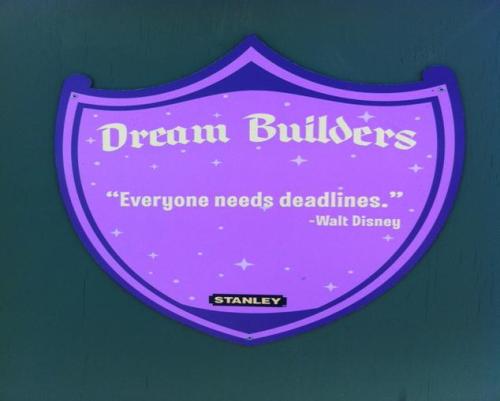
The first sign that caught my eye was this one.

It’s a short quote of just three words, but how profound those three words are in the world of business. Once I read that sign, I immediately started thinking about all the projects that I had going on back at work. I know that is a pretty sad thing to think about while on vacation, but when something hits you, you go with it. While I don’t have any projects as big as building an entirely new Fantasyland at the most famous amusement park in the world, they are still important to the success of our company.

I started mentally going through the list of projects asking myself if we had set firm deadlines for each of them. Sadly the answer was “no.” We had way too many projects for which we had not set hard deadlines for completion. We might have said something like “we are going to get that done before the end of the year” or “that will happen in Q3” we were not consistently setting specific dates. We were setting those dates for some, but not all.

I then starting thinking about how each of those projects were progressing, and in most cases the ones that had well defined deadlines were moving along as planned, while the “we will get it done when we can” projects were idling or making painfully slow progress. It made me mad at myself (not so mad that I didn’t enjoy WDW) for not managing those projects better and set in my mind that when I returned from vacation that things were going to change.

The week after returning from Disney, I met with the rest of the technology services management team and talked about the revelation I had at Disney World. We all agreed (well they said they agreed) that every project needed a deadline and every project needed a defined project manager. If there was a project that did not have a deadline and did not have an “owner” we needed to step back and ask if this was really a project.

To support this effort we also began leveraging features within Microsoft Sharepoint to manage our portfolio of projects and keep track of deadlines and progress on each of our projects. As we populated that portfolio, I was surprised to see that we had over 30 projects in progress, with another 15 in planning stages and another 15 that had been identified but not yet been started. Wow , 60 plus projects – that’s a big number of projects for a team of less than 50 people.

We also changed up the structure of our weekly management calls. Prior to this revelation, our weekly calls were me talking about whatever was on my mind for 10-15 minutes and then opening up “the floor” for updates from the group. Now we still spend 10-15 minutes of me talking about what’s on my mind but we now spend the remaining 15-20 minutes going through our project portfolio and discussing projects that are either at risk (Yellow or Red status) or have target deadlines coming up in the next two weeks. We have only done a couple of calls under this new format, but it feels like we are have more targeted discussions and talking about the things that really matter. Hopefully this translates into better overall execution on all of our projects.

So thanks Walt for having a vision to create Disney World – without it I might not have had this revelation.

And one more thing, I love the Rock-n-Roll roller coaster. Aerosmith, high speed and loops – how could it be anything but awesome.

Take Your Foot Off the Brake: The Road to Ingenuity

One foot on the brake and one on the gas, hey!
Well, there’s too much traffic, I can’t pass, no!

The opening lines of The Red Rocker’s (Sammy Hagar) 1984 hit, I Can’t Drive 55. Now I don’t think Sammy nor most people that crank this song up when they are hitting the highways think about these lines in any way other than an expression of a desire to drive fast. And trust me; I have done my share of exceeding “55” with this song blaring in my car. But today, I am putting a little twist on these lyrics.

All too often in our professional careers and even in our personal lives, we struggle with expanding our role; adapting to change; leveraging ingenuity to solve a problem we are facing. To put it simply, we struggle with being leaders. And why do we struggle with these things? We get caught up in the administrative chaos that exists in our jobs; we become content with the status quo mindset of “that’s what how things have always been done”; we fear failure from trying taking on new roles or doing things differently. In short, there are times where we apply the brakes and at the same time press down on the gas pedal – yet are confused on why we are not getting where we want to go. And other times we let off the brake but the “traffic” in our jobs or our lives get in the way of us moving forward, and we are afraid to change lanes to get around the traffic. We become stuck and our ability to be flexible and quickly react to our rapidly changing world is diminished.

As you may recall several weeks ago, I made an entry titled “What’s Love Got to Do With It? In the entry, I referenced a book Heroic Leadership by Chris Lowney. Thanks to an Austin to Boston roundtrip recently, I had a chance to finally read the book. Good book; a little deeper in history than most “self-help” management tomes which made it even more interesting for me since I am a bit of a history geek. So as fate would have it, days after reading the book, a couple of events happened in my world that made me immediately go back to that book and think a little more about one of the core Jesuit principle presented in the book, “ingenuity.”

I have been involved with a new(er) Catholic high school, St Dominic Catholic High School, in Austin for close to five years – since the start of a large capital campaign to gather funds for the construction of the school facilities and now as a member of the school’s finance committee. It has been extremely exciting and rewarding to be a part of the history of the school from the beginning. The school has been fortunate to have a charismatic principal, Kevin Calkins, from day 1 – actually even before day 1 since he was hired at the start of construction. Prior to coming to Austin, Kevin worked at a Jesuit high school and attended a Jesuit college. Recently he announced that he was leaving the school to accept a position as Assistant Superintendent of schools for the Archdiocese of New Orleans – which happens to be headed by the former Bishop of Austin who was instrumental in bringing Kevin to St Dominic Savio 4 years ago. When I first heard the news, my initial reaction was “how dare he leave the school just as it was getting stable.”

The same week I received a call from Mike, a long-time co-worker. While he is supposedly a Texas resident, Mike has spent most of the past 10 years in other parts of the world, including long-term work stints in Australia, Philippines, Belgium, and United Kingdom. He is what I call a “potted plant”, the guy that picks up and moves at what seems a moment’s notice for the next job assignment. I never wanted to be the “potted plant” but I have always had an admiration for those that play that role. In my prior career in management consulting, there were numerous potted plants that simply picked up their “roots” and moved to the site of the next long-term engagement. That role is a valuable one for many companies as it provides an anchor in a new or far away outpost. The reason for his call was to let me know that he was moving yet again, but this time the move was out of the company. After 15+ years of going anywhere, anytime for the company, he had decided to take his skills and his career elsewhere. My first reaction was “wow, I never thought he would leave this place.”

From reading the book, I go a much better idea of what this principle of “ingenuity” is all about. Usually when I see or hear the word “ingenuity”, I conjure up visions of MacGyver (late 80s TV show for you youngsters) disarming a nuclear warhead with nothing but a paperclip, a stick of chewing gum and the laces from his shoes. But it is deeper than that, the Jesuit concept of ingenuity is developing leaders that can confidently innovate and adapt to embrace a changing world to achieve the aim of the company which is to “help souls.” In order to do this, the Jesuits attempted to avoid occupations that tied them down or limited flexibility – somewhat contrary to what most of us think of as a Jesuit mainstay which is the vast network of schools and universities they established. They vowed to ready at any hour to go to any part of the world to carry out the mission of the company. Put another way, the Jesuits followed a concept of always having one foot off the ground – every ready to take the next step, never to be caught flat-footed. Pretty heady stuff when you consider this was a concept formed 450+ year ago when travel to other parts of the world, was more than a 2 hour wait in an airport security line and a 12 hour flight from LA to Asia.

So thinking back to Kevin and Mike, they are both great examples of maintaining flexibility and being poised to take on the next challenge. Take Kevin, four years ago he left a great position in California to move to Austin and become the principal of a school that had zero students, zero staff, and zero buildings. In four short years, he has been a key leader in building the school literally from the ground up. Next month the school will have its first graduation ceremony and next year will have close to 400 students – and during the short three years of existence the students at the school have excelled in academic, sports, and fine arts competitions. If this isn’t ingenuity, I don’t know what is. Perhaps for Kevin his mission in Austin is done, he helped build a vibrant, successful school in three short years. And now he is poised to take on a new adventure in New Orleans. While I am sure he will face many challenges there, I am also confident he will “help souls” there as well.

Now let’s look at Mike. Mike has been the ultimate “corporate team player” and a strong leader. I don’t know for sure, but I am almost certain he holds the record for most offices (and countries) worked in throughout the entire company. He has been ready at any hour to pick and move to some far away location at the request of the president of the company. In doing so, he became very adept of melding the way in which we approach business with the norms of the region. In doing so, he brought insight to others, including me, about the operations of our far flung operations and how to get things done in those other parts of the world. I saw him as the glue that helped bind together our various international operations with the US-based operations. And now he is taking that same enthusiasm for tackling new markets to another company that has big plans for international expansion.

You might be thinking at this point’ “Great, Robert. But, I am not some 16th century Jesuit priest, and I am not the type to pick up and move to another part of the country or world. So I guess I am just stuck on the freeway with Sammy Hagar.” Not so fast; I think this ingenuity thing applies to all of us.

While the above are more extreme examples of flexibility and living with one foot off the ground, there are many less extreme things we can do in our careers to not get stuck in the rut of the everyday and be nimble. For example, last year, we were having issues with some local telecom carriers in Manila. The issues quickly escalated and at Noon on a Friday had reached a point where I knew I needed to go there in person. By 2p that afternoon, I had airfare booked for me and two others and early on Sunday morning, we boarded flights to start the long journey to the Philippines. That is not how I prefer to plan trips, especially ones half way around the world, but it was what was needed. A few years back, I recall asking a Unix admin to be on a flight to Boston in 3 hours. He immediately said “yes”, left the office to swing by his house to grab a change of clothes and was off to the airport. We bought his ticket while he was driving towards the airport. A great example of being ready at any hour to go where needed.

There are other examples of being that are tied related to moving or travel as well. In the world of IT, there are always server admins and network engineers on call. I have lost count of the number of times in the past 10 years I have called someone in the middle of the night to troubleshoot an issue. The good ones, the one I considered strong leaders jumped in every time without hesitation. Ingenuity is also about the people that don’t fight a change in a process, but instead embrace it. They don’t get caught in the “but that’s the way we have always done it trap”, they look for ways to improve operations, they champion change within the organization. Each person that jumps in at moment’s notice or brings up new and better ways to complete a task is a true leader. A job title does not make a leader; ingenious, nimble actions make a leader.

Ingenuity is also about not getting complete absorbed with the administrative avalanche that face many workers – this is especially true for people in managerial roles. It is easy to spend entire days doing nothing but cranking through administrative tasks – approving purchase order, reviewing change management work orders, approving time off, analyzing financial statements and responding to emails. I have found myself in this trap many times. You look up at the end of the day and you realize that you have done nothing to lead the business, nothing that in any way shape or form improves the ability for the company to achieve the established goals. You were busy all day, but not busy on the right things. You were in your car, but with the foot firmly on the brake. We must all work each day to make to find time to make a positive difference in our company, it does not have to be huge differences, but we must make a conscious effort to not drive with our foot on the brake all day.

So I wish the best of luck to both Kevin and Mike in their latest adventures. The organizations they are leaving behind are better off because of their presence and the ones they are going to will certainly benefit from having them around. And for the rest of us, we must all try to remember that to move forward we must ease off on the brake pedal and sometimes even change lanes and get out of our comfort zone to become true leaders.

With a little ingenuity, we can all drive “55”
Business Lesson from a Nurseryman: Change Can Come Up Roses

Ch-ch-ch-ch-Changes
(Turn and face the strain)
Ch-ch-Changes

You should know by now that I like music, and this time I have turned to David Bowie to lead us in to this installment.

I grew up in East Texas near Tyler, the self-proclaimed Rose Capital of the Nation. The rose is right up there with Earl Campbell (The Tyler Rose) and Sandy Duncan as the most famous things to come out of Tyler. Beyond just being from Tyler, I have a special connection to roses. My grandfather, Frank Goldwater, was a nurseryman. He like many others in Tyler, grew and sold roses as a living. His business, Lone Star Rose Nursery, is still in the family today.

Like most agriculture-based operations it was not a glamorous business. While I never officially worked in the fields or warehouse (my older brother did for a summer or two), I saw first-hand what was involved. I remember getting up at the crack of dawn and having an artery clogging breakfast before tagging along with my grandfather as he made the rounds to the numerous rose fields, checking out things at the warehouses where plants were processed or riding in his El Camino as he made some small delivery in the area. While it was cool to see, I knew early on that life in agriculture was not for me and that I was destined for a cushy office job.

As I mentioned, Lone Star Rose Nursery which was founded in 1951, is currently owned and operated by my uncle, Sam Goldwater. This past weekend there was a big article in the Tyler Morning Telegraph about the rose industry that focused in on Lone Star Rose Nursery. It was really cool to see the “family business” in the spotlight. Much like it is cool to walk into my local HEB store and buy a rose bush from Lone Star Rose Nursery.

Here’s some excerpts from the article from the Tyler paper and you can watch an accompanying video of the interview:

This (company) represents what the business in Tyler is now,” Goldwater said. “It’s a changing industry. I used to grow a million roses, but I don’t grow them anymore. The rose industry is alive and well — we’ve just transferred from growing to distributing.” Goldwater said his transition from grower to distributor did not unfold because roses are falling out of favor with customers. It’s mostly because East Texas weather can be wicked, creating challenges in growing consistency and quality. In the 1930s, Tyler was prime peach country, but after disease wiped out a sizeable number of fruit trees, many farmers switched to growing roses.

Eventually, many rose growers became frustrated with finicky weather conditions that prevail in East Texas and opted for change. “There used to be about 150 growers here (in Tyler), but there are less than 10 now who actually grow,” Goldwater said. In spite of the shift, the Tyler area retains a heavy presence in the industry, processing and shipping millions of plants annually, according to Texas A&M University. “About 75 percent of the garden roses in the U.S. find their way through Tyler and are distributed throughout the U.S.,” Goldwater said. Most of the nation’s roses are grown in Arizona and then shipped elsewhere, many to Tyler. Goldwater buys bare-rooted plants from suppliers in drier states, packages them and distributes them for sale in garden centers across the United States. In this mobile society, it’s not uncommon for Lone Star to receive bare-rooted roses from Arizona, package them and ship them back to Arizona, the nurseryman said with a grin.

“I thought I would grow roses my whole life,” he said. “Things just evolved.”

“Our business has been growing every year,” said Goldwater, who was educated at Texas A&M University. “I remember when I didn’t have a forklift — now we have five.”

I will admit that over the years, I have not kept close ties to what is going on in Tyler and more specifically with the rose business. As I read the article, I was actually surprised to read that my uncle’s business was no longer actually growing roses. How could this be? How could a rose business still be a rose business if they did not grow roses?

That business I remembered having hundreds of acres of rose bushes with workers planting, grafting, and digging bushes is no more. The business, in order to eliminate the risks of unpredictable weather causing damage to the plants and to open up new growth opportunities, has changed from being a farming operation to being a processing operation. An operation that now provides rose bushes to stores like HEB, Menards, and other large national and regional home & garden outlets around the country. Once I was over the shock, I was impressed that a country farmer (and an Aggie no less – those of you in Texas will get this) had the foresight to change the business model from what he really knew (growing roses) to what was needed (processing roses) to ensure the long-term growth and success of the business. By the sound of it, the decision has been a good one.

I think we can all learn from this story. Businesses must continually change. Change the mix of products and services offered to the market. Change the markets in which they sell. Change the technology used in creating and delivering products and services. Change is inevitable in business and also critical to long term survival of the company. Just ask former employees of Blockbuster or Kodak about the need for change. But change is not easy. I can only imagine the resistance my uncle faced, and perhaps even resistance from himself, in ceasing the “farming” part of the rose business.

Leaders at all levels of a business must constantly be on the look-out for new opportunities to improve the business and have the courage to recommend and implement those changes. If leaders are not thinking about better ways to manufacture products or deliver services, assessing what products to add or discontinue, evaluating new markets, and overall evolving their business, then they are failing to be good leaders. Note that I use the term “leaders” and not “executives” or “managers.” This is intentional. Leadership in business (and other parts of life) is not synonymous with management. Leaders can and are at all levels of an organization. It is not something that is reserved only for certain levels of a company hierarchy. Every person in a company is a leader through their daily tasks and activities. What we do and how we do it, impacts the people around us and even those not right next to us. As I attributed to Kip Tindell (Container Store CEO) in a recent entry : we must be aware of our “wake” and how far it extends beyond us.

So this week, I take my hat off to Uncle Sam and say “thank you.” Thank you for keeping the “family business” alive and well and thank you for showing all us in the business world that change can be a good thing.

More Reflections from the Course

We did a first this past week in the Neill household – we had a family golf outing. I have to say that it was a very interesting foursome.


I am far from being a great golfer. I play 4-6 times a year, which means I am at best a hacker. My wife hadn’t played a round of golf in 20 years before this family outing. My older daughter had taken a few lessons over the past three years but is mildly and I mean very mildly interested in golf. And finally my younger daughter as you know from prior blogs is the avid golfer of the family.


I took an afternoon off from work, which I highly recommend people do from time to time, and we headed out to Harvey Penick Golf Campus. Harvey Penick is a 9-hole course geared toward the less advanced golfer; a great place for a round when you have a foursome like what I have described. This is also the home to First Tee of Austin (www.thefirstteeaustin.org/) which a great organization helping the youth of the Austin area. It is not luxury country-club experience but is an enjoyable track that also has a few challenges.


The round was fun. There were lost balls, numerous whiffs, a foot wedge here and there, and with the older daughter a few blatant violations of the rules of golf. There were also a few laughs in there and some smiles. The scores were nothing spectacular – one each in the 40s, 50s, 60s, and 70s. We will just leave it at that.


As usual when the time on the course was done, I reflected back on the round. I was playing with a brand new set of irons I received at Christmas – replacements for the ones I had used for 17 years. All I can say is “Wow.” Clubs make a difference. I was hitting shots I never hit before in my life. It made we wish I had asked (or just gone and bought) for new clubs years ago. It was also obvious that my wife (and she said it before I did) needs some lessons after a 20 year hiatus. I won’t say any more than that because I do not want to get in trouble. It was also very apparent that while the older child has potential and some basic skills, she lacks the desire and patience to be a golfer. Golf is just not her thing. And finally the young golfer of the family once again showed that she has a beautiful swing and a head for the game but lacks the consistency at this stage of her development as a golfer. She also reminded me that trying too hard to impress (say your mother who has never seen you on the course) can sometimes mess up your game.


So what I saw on the course on that fun filled afternoon, an afternoon that is sure to be talked about for years to come, is also something many of us also see in our professional lives on a regular basis. Each member of the foursome highlighted a critical factor for success in business. These four factors are:

  1. Tools matter
  2. Training matters
  3. Passion or at least an interest in what you do is important
  4. Consistent execution is a must


Many of us have either said or heard someone else say something like, “if I just had a new computer I could get more done or make more sales.” In my role, I certainly hear this all the time. There always seems to be a need for the latest laptop, iPhone/iPad, MS Office Version, cloud app, and on and on. I hear it so often that at time all I hear is the buzzing noise of people wanting things versus needing valuable business tools. Employees and line managers play an important role in making sure that they have the tools they need to be successful. They must take steps to make sure that requests for new tools convey the business value to be realized and not just be another “ask” to spend money. Just as important, decision makers must take steps to not fall into the trap of just hearing the static and actually listen to what front line employees are saying they need to be more productive.

As much as tools matter, so does training. Employees must have the knowledge required to execute daily tasks, use existing and new tools, and keep up with changes in the business’s environment. Many people think training is the sole responsibility of the company, not the employee. Many have the expectation that their company must foot the bill for all training and/or that the only training needed is that which is mandated by their employer. While companies certainly need to make an investment in providing task specific training, training on internal processes/procedures/policies, and training for tools that are used in the execution of tasks, employees must also make a personal investment in training. This personal investment can be something as informal as reading profession specific articles and white papers; or attending vendor or industry-group sponsored events; or something a little more formal like online training courses, or even very formal training such as obtaining a professional certification or a college degree. This personal investment can not only add value to your current company; it can also help propel your career to a higher level. In the end, whether company-supplied or employee provided, the best training is the training you want to receive and that you have vested interest in completing.

Be Passionate about your job. I have written about this one already (see Life is Short: Find Your Passion) but it is worth writing about again. Your level of passion (or at least some semblance of interest) for your job/career plays a huge part in the quality of your work performance. The more you like what you do, the more likely that you will give your all when executing your daily tasks, and thus to more value you will add to your company. Over time this will result in success for your company and for you personally.

You can have the tools. You can have the training. You can have the passion. But the real secret to success is putting those things together on a consistent basis. Put another way – in order to achieve long-term success you must flawlessly execute on a consistent basis. This is much easier said than done. We are after all humans, not machines. This means that none of us can be “on our game” all the time. There will be days or at perhaps parts of days where we fail to be firing on all cylinders. The key is to bring your skills, your tools and your passion together as best you can on a regular basis. Consistent execution is truly the key to long term success.

So once again, a round of golf has provided me with not only valuable time with members of my family but also a time to reflect about my own career and business in general. Fortunately for the Neill family our shortcomings on the course did not hinder what we were trying to achieve on that pretty Spring afternoon – we were spending time together and making memories. If only success in the business world could be so easy.

What’s Love Got to Do With It?

“What’s love got to do, got to do with it?
What’s love but a second hand emotion?”

I don’t think that Tina “The Afterburner” Turner was posing a business question when she was belting out this hit in 1984, but I am asking that question now in 2012.

Over the past two weeks I have had the pleasure of listening to two interesting business leaders. The first being Kip Tindell, co-founder and CEO of the Container Store and a disciple of the Conscious Capitalism movement. The second speaker was Chris Lowney, a former Jesuit seminarian and former Managing Director at J.P. Morgan & Co. I had the opportunity to listen to Kip Tindell at a Austin Business Journal breakfast event in downtown Austin. Chris Lowney was the keynote speaker at a recent fund raising gala for St. Dominic Savio Catholic High School, which is by far my favorite Catholic high school in the entire world.

You are probably wondering already what these two speaking events have to do with each other. The answer is “Love.” More specifically “love in business”, not love in the sense that would send Human Resource directors screaming down the halls or have plaintiff attorneys salivating at a multi-million dollar lawsuit. Not even the type of love I found 19+ years ago when I met my wife at the office. But love in very different kind of way. As I sat at breakfast listening to Kip Tindell, my mind did a double take when he said “you can build a much better organization on love than on fear.” I was thinking “what in the hell is he talking about, there’s no place for love in business”, but the more I listened to his philosophy the more it sunk in that he was not talking about love in a romantic sense. It was somewhat interesting that two weeks later as I was sitting at a fundraiser dinner, I heard a former Wall Street banker say that in order to be successful businesses needed to “create an environment filled with greater love than fear.”

Those two “love” statements stuck in my head, and I started wondering if there was a deeper connection between these two seemingly unconnected individuals. So I did a little digging, and it did not take long to find the common thread. I already knew from his keynote address, that Chris Lowney was a former Jesuit seminarian and thus presumably well versed in their teachings. However, I knew very little of Kip’s background other than he attended my alma mater, THE University of Texas, and had been at the top of the Container Store since its founding 1978. So I wanted to know more, because I was pretty sure that he didn’t learn about “business love” at the UT, as I have two degrees from the UT Business School and never once recall the word “love” being uttered by a professor. A quick Google on Kip Tindell and I had my answer. It turns out that Kip attended Jesuit College Preparatory School of Dallas and that the Jesuit philosophy he learned there has served as a basis for how he runs the Container Store. So the common thread: Jesuits.

I do not have much exposure to the Jesuits. I attended public schools from kindergarten through graduate school and did not grow up in the Catholic Church. While I am now Catholic, I still have not spent much time learning much about the Jesuit teachings. I am not going to dive into the history of the Jesuits, but very briefly “the company” was created in 1540 by St. Ignatius Loyola. The Jesuits are probably best known in the US for the establishment of schools, including 28 colleges and universities. They also established leadership principles that have guided Jesuit leaders since the 1500s and are still taught to those attending Jesuit schools.

Based on the keynote from Chris Lowney and some brief research on my own, I have gained a basic understanding of the four principles of the Jesuit approach to leadership. These four core principles are:

Self-awareness: understanding one’s own strengths, weaknesses, values, and worldview.

Ingenuity: confidently innovating and adapting to a changing world

Love: engaging others with a positive attitude that unlocks their potential

Heroism: energizing yourself and others with heroic ambitions and a passion for excellence

;

Like I said, I have a basic understanding of these four principles but each seems very complex and multi-faceted. As I was in a social setting when he spoke, I was not fully engaged in his every word and certainly was not taking notes or even making detailed mental notes on his insights. Fortunately Mr. Lowney wrote a book Heroic Leadership: Best Practices from a 450-Year-Old Company that Changed the World so that I can read it and gain a deeper understanding of each of these principles. Once I get that done, I am sure there will be another entry or two about it.

So I then thought back to Kip Tindell’s session. As I was in my professional mode for that one, I jotted down copious notes during his talk. Here are a few of the nuggets of wisdom from Kip during that breakfast presentation:

“You can build a much better organization on love than on fear.”

“Communication and leadership are the same thing.”

“Communication is act of compassion.”

“Mind your wake. Our wakes are bigger than we think, everything you do – and what you don’t do – impacts the people around you more than you think.”

“Find a place where you can be you.”

“We should all act like we are the CEO, Chairman and own 100% of the stock.”

“Always believe everything matters.”

“Kids are raised to think only logic applies to business. But some really wise person once said that intuition is merely the sum total of one’s life experience. If that’s the case, why would you leave that at home when you come to the office?”

;

As I drove away from downtown Austin that morning, I thought “wow, this Kip guy is a revolutionary thinker that sees business in much different light than the traditional CEO. He is a cutting edge business leader.” And you cannot argue that his leadership philosophy doesn’t work, as the last I checked the Container Store has seen 15-20% year-over-year growth for twenty-five plus years and did not lay off a single employee during the recent bad years we have all experienced. I doubt many companies can match that track record. But as I piece things together and replay his talk in my mind against the keynote from Chris Lowney and the brief research I have done on the Jesuit leadership principles, I am thinking that Kip is not a revolutionary after all. Instead I am beginning to think he is an “old school company guy” – a 450 year old company known as the Jesuits.

;

So does love have a place in business? If love is indeed “engaging others with a positive attitude that unlocks their potential”, then yes, love is a key to success in the world of business.

;

;

;

;

;


Lessons from the Course: Part II

This is a follow up to an entry I made several weeks back on Lessons From The Course

I once again had the privilege to serve as caddie for my daughter as she played in another local golf tournament.  If you recall from earlier this month, my last experience as caddie was less than perfect.  So the question is: Did I learn from that experience?

Before I get to the answer to the question, I need to set the stage for my state of mind as I was driving her to the course on a blustery (the winds were blowing 15-20 mph) Sunday afternoon. 

In addition to serving as my daughter’s caddie, I also co-coach her youth league basketball team.  Her last game of the season was on Saturday.  The season had been full of intense games – almost too intense for “church league” hoops for 3rd and 4th graders.  The team had some good wins, including one with a game winning shot as time expired to snag victory from defeat.  There were also some tough losses in which there was some unneeded tension with opposing coaches and officials.   And during all the games, there was lots of sideline coaching – I dare shamefully call it “micro-coaching.”

Our routine for the prior 7 games was to gather the players 10 minutes before the game and go over strategy and plays.  Remind them to set screens on offense, get rebounds and how to fight through screens on defense.  Half-time was spent going over what was working well, talking about shooting percentages and begging them to get more rebounds.  For the last game of the season, my co-coach asked me “so what do you want to tell them for pre-game?” I paused for a moment and said “Nothing, other than go have fun.”  So that is what we told them – “Go Have Fun.” No talk of screens, or spread offense sets, or help defense.  As the game unfolded, we yelled very few instructions from the sidelines, and for the most part we just let the girls play.  We provided words of encouragement when they came out of the game and provided some individual guidance as we rotated players but the “micro-coaching” was no more.  Surprisingly they called out plays, set screens, got rebound after rebound and helped each other on defense – all without two “forty-something” coaches constantly yelling out instructions at them.

It ended up being the most enjoyable game of the season – more enjoyable for the players; more enjoyable for the coaches, and I think even more enjoyable for the parents watching the game.  Our girls ended the season with a 22-12 victory.  More importantly, after two months of practice and playing they were able to do it without constant coaching from the sidelines.  They had reached a point where that that was no longer needed.  These young girls were becoming self-sufficient on the court.

Fast forward to Saturday night, a friend of mine posted a link on Facebook to an article, Are We Raising a Generation of Helpless Kids?  The article basically argues that parents of Gen Y kids (those born between 1984 and 2002) have been consumed with protecting their children to a point where Gen Y kids are not prepared to be self-sufficient adults.  It goes on to say that parents of this generation do everything possible to make sure their kids do not fail.  Essentially it states that many parents have been micro-managing every aspect of their children’s lives, carefully orchestrating each moment to create the perfect childhood. It was a thought provoking article – not only because my own kids are in the tail-end of that generation but also because the older kids of Gen Y are becoming more common place in the work environment.  My initial reaction was that the article was directionally correct but not spot on to the point where my kids and certainly not I as a parent could be included in that generalization.

So now fast forward to Sunday afternoon and that drive to the golf course.  I had my mind set that I was not going to be the overbearing caddie/golf advisor/dad as my precious 9 year old daughter navigated yet another challenging golf course.  As she warmed up, I kept my distance.  I handed her club after club and she went through her pre-round warm up – but I said little other than the occasional “nice shot” comment.    The first hole was a long par 5, into the wind, with a water-carry in front of the green.  What a way to start a round.  You could tell the group in front of her was grinding through the hole and her group found it a challenge as well.  But I was trying hard to keep my word and not micro-manage her play, so I kept my guidance to a minimum.  After a penalty stroke for making a splash and a brutal 3-putt, she painfully recorded a triple bogey on the first hole.  

The next three holes would test my promise to not be all in her business, to not direct her every move.  I could feel the urge to line up every shot for her, to tell her how hard to swing on each stroke.  And I think she could feel it too.  The 4th hole was especially painful; a pretty drive took a bad bounce to the left and ended up in a greenside sandtrap.  A bounce to the right and she would have been looking at a 10-12 foot putt for an eagle.  As she entered the trap, I could not resist reminding her to not over hit the shot as the green was small and on the other side of the green was a steep slope down to a creek.   So she blasted it out of the sand and ended up off the green on the other side of the hole, down the hillside, resting inches away from the creek.  I could feel myself shaking my head, basically saying without saying “I told you not to do that.”  A decent pitch from the edge of the hazard and a follow-up pitch had her on the green “in 4” – about 15 feet away from the hole.  Four putts later, each with more and more verbal direction from me, she finishes the hole.

As we walked to the next tee, I started telling her how important it was to make good chip shots around the green and that 4-putting was just a killer.  She finally looked at me with those sweet brown eyes of hers and said “Dad, I know what I need to do.  How about for the rest of the round, you just let me ask you for advice when I think I need it.”   How could I respond to that, other than to agree and think to myself how pitifully I had failed to uphold my promise to not micro-manage her round? 

So on the next hole, I handed her the driver and quickly removed myself from the tee box.   She lined herself up and hit a pretty drive, she followed that up with a great approach shot into the green and then two-putted for a par.  The only advice I provided was when she asked “9 iron or pitching wedge?” on the approach shot. 

All I could do when that par putt drop in the cup was to hug her and give her a big ole kiss.  Not because she made a par, but because she once again taught me a lesson.  She showed me that there are times when you have to let go and give your kid a chance to succeed or fail on her own.  She was becoming self-sufficient on the course and little by little in her life as well.

So you know I like to somehow tie these back into the world of business, so here goes.  Much like I as a parent have to let my kids fly on their own even if at times it ends in failure, I as a manager have to let my employees fly on their own as well.  I have to provide employees with training and instruction on what to do, make sure they have the right tools, and put them in situation where they can succeed.  But assuming those things are in place, it is up to the individual to actually execute.  I should be there to provide advice if asked, but I cannot micro-manage every aspect of that server configuration, that line of code, or those detailed tasks during a midnight network maintenance.  Employees must ultimately execute the tasks assigned to them without constant manager intervention – even it at times the results are less than perfect.  We learn so much more from successes and failures when they are actually ours – and that is how we become better at our jobs.

So back to the question:  Did I learn from that previous experience on the course?

I think the answer is “Yes.” 

But I learned from this one as well.  I once again feel more enlightened after spending time on the course with my daughter.  Perhaps I should encourage her to enter more golf tournaments – at this rate I might become the wisest man on earth.

Life is Short: Find Your Passion

A friend of mine posted on Facebook the transcript of a conversation she had recently with her nine year old daughter:

Daughter: “Mom, what kind of job do you want me to have when I grow up?”

Mom: “I want you to have a job that makes you happy and makes you feel like you want to get out of bed and go do every day.”

Daughter: “good, I’m gonna work at Baskin Robbins!”

The way in which this young girl processed that great advice on the fly was awesome. She very quickly put together that:

1) She liked ice cream (and who doesn’t);

2) Ice cream made her happy;

3) She should be happy at her job;

4) If you did some crazy algebra, you could end up with Job = Ice Cream and if Ice Cream = Baskin Robbins, then Job = Baskin Robbins.

That logic is hard to argue with on so many levels.

The timing of her post and my reading of this mother-daughter exchange coincided with my preparation for presenting the final ‘habit” from the Infoworld article 12 Effective Habits of Indispensable IT Pros – Ditch the Slackers, Take on Dirty Work, Do it with Data written by Dan Tynan. If you recall the article was the impetus for me starting this blog. You may also recall from two of my other posts, that after reading the article I decided to share each of the twelve habits with my team and provide some “Robert Not Bob” wisdom to go along with each.

The twelfth and final habit presented was: Know When to Fire Yourself

Sometimes the best way to become indispensible as an IT pro is to step away from a stifling career path, even if that means branching out on your own.

“I boosted my career by starting my own company,” says Lowe, of Innovator LLC. “I doubled my take-home pay immediately, set my own hours, and got to work on really interesting things with highly motivated people.”

The notion that a “successful career” implies a steady progression of higher-paying jobs within a company or industry just doesn’t apply any more, he adds.

“A successful career today is a journey on which you discover and do what you love,” he says. “If that happens to be offering businesses innovative ways of changing their work flow to achieve new levels of productivity and efficiency, that’s great. If that happens to be giving guided tours of canyons in Utah (instead of applying the advanced math degree you earned at university), that’s also great.”

When you’re out on your own, being indispensable means solving problems and letting others reap the rewards, Lowe says. “That’s pretty much the essence of my consulting career. I innovate, they prosper, we both win. The next time the client has a challenge, they call me first.”

My Commentary: Assuming you sleep 7 hours a night and work an average of 50 hours a week with another hour each day traveling to/from work, many of you spend close 50% of the hours you are awake each week working. That being the case, you better enjoy your work – otherwise you are spending half your life doing something you don’t like. Life is just too short for that to be the case.

If you are not happy and motivated to be at work, then more than likely the performance you turn in every day is not at a high level either, which means your unhappiness negatively impacts your co-workers and your company. I have seen all too often that a unhappy employee drags down others around them, creating a negative environment that begins to jade entire departments. I often think that unhappiness in the work place is contagious.

As a manager you hope that each and every employee enjoys his/her job even if at times it is a little challenging or frustrating. But in reality I know that is not the case, especially in larger organizations where there is more than likely at least one person that just can’t stand coming to work each day no matter what. While you can attempt to coach people up, inspire them and make the workplace “fun” there are some people that will just hate what they are doing and nothing will change that fact.

While not everyone is cut out to be their own boss and go out on their own as suggested by the author in the above referenced article; people do, even in our challenging economy, have choices about what they do each day. My advice to everyone is:

If for some reason you are completely miserable with your current job, go find something to do that makes you happy. It may take weeks, months or even years to find it, but don’t give up finding your work passion. Life is too short to spend half your waking hours being miserable.

If a nine year old girl can come to grips with that within seconds of hearing words of wisdom from her mother, surely we grown adults can figure it out as well. If only we could all go work at Baskin Robbins…..